PTCA Balloon Price in India: SC, NC, CTO and Drug-Coated Balloons
Almost every angioplasty uses at least one balloon. This guide explains the main balloon types, what each costs in India and what a cath lab should check before buying.
A plain PTCA balloon catheter (semi-compliant or non-compliant) is listed at about Rs 2,750 to Rs 7,000 in India, and specialty scoring balloons at about Rs 14,000, based on TradeIndia listings in October 2026. Drug-coated balloons cost more: listings we found ranged from about Rs 6,400 to Rs 29,000. Unlike coronary stents, balloons have no NPPA ceiling price.
PTCA Balloon Price Ranges in India
These are listed prices from Indian online marketplaces in October 2026. Most are dealer prices for single pieces. They usually exclude GST, and hospital bills can be higher.
| Balloon type | Listed price range | Main use |
|---|---|---|
| Semi-compliant (SC) PTCA balloon | Rs 2,750 to Rs 6,800 | Opening a narrowed artery before a stent (pre-dilation) |
| Non-compliant (NC) PTCA balloon | Rs 3,400 to Rs 6,000 | Expanding a stent fully at high pressure (post-dilation) |
| Scoring or specialty NC balloon | About Rs 14,000 | Hard, calcified narrowings |
| Drug-coated balloon (DCB) | About Rs 6,400 to Rs 29,000 | In-stent restenosis and small vessels |
On TradeIndia, for example, an Abbott NC Trek balloon was listed at Rs 3,800 to Rs 6,000, a Terumo Ryurei balloon at Rs 5,800 and an RX PTCA dilatation catheter at Rs 6,800. On IndiaMART, a sirolimus-coated balloon was listed at Rs 6,400 and a drug-eluting balloon catheter at Rs 29,000.
What Is a PTCA Balloon?
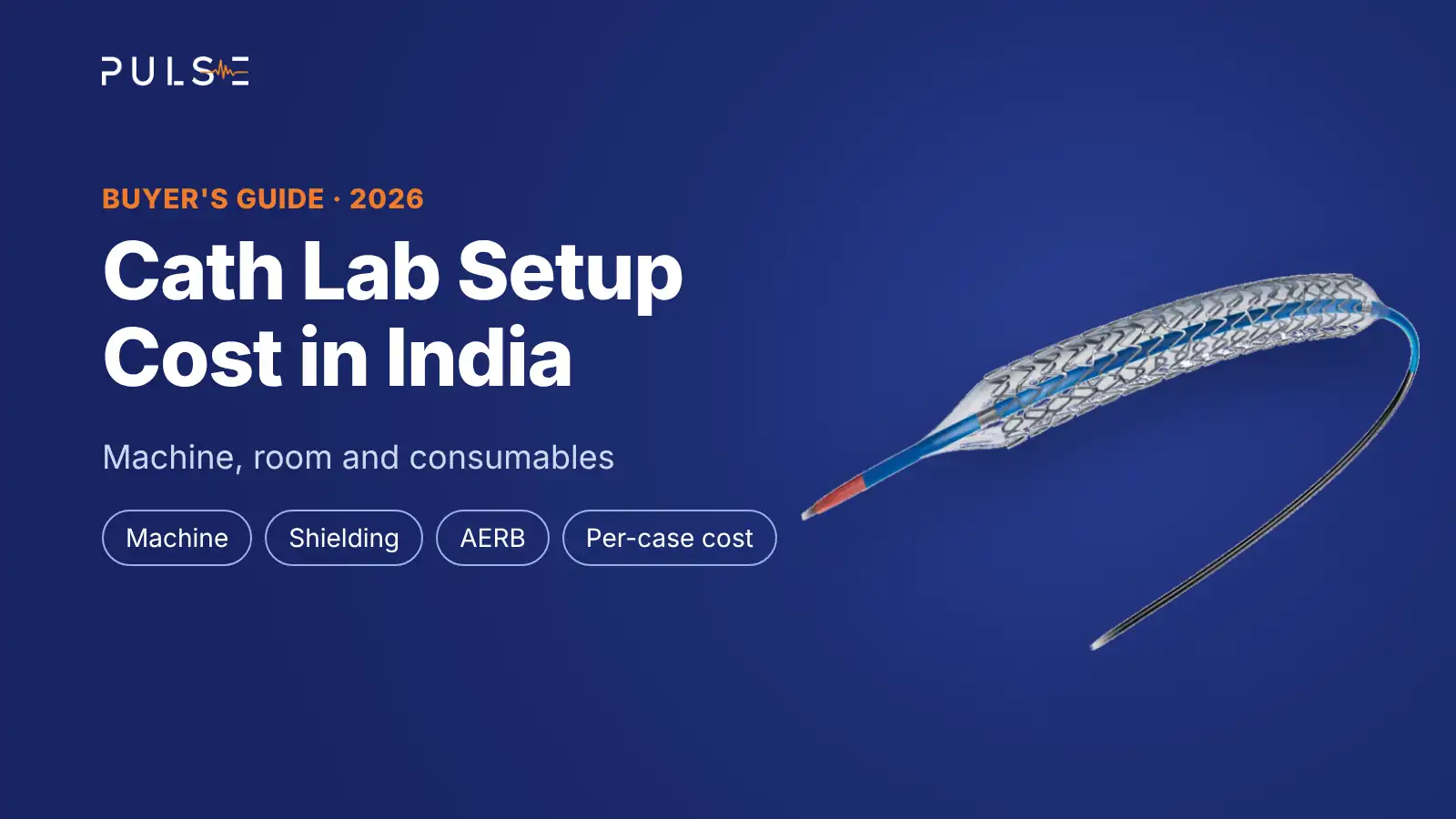
PTCA stands for percutaneous transluminal coronary angioplasty: opening a narrowed heart artery from inside, through a small cut in the wrist or groin. A PTCA balloon is a thin tube (catheter) with a small balloon at its tip. The cardiologist slides it over a guidewire to the narrowing and inflates it with an inflation device. The balloon presses the fatty plaque against the wall and widens the artery. It is then deflated and removed.
Most angioplasties use more than one balloon: one to prepare the artery, the balloon that carries the stent, and often a high-pressure balloon to finish the job.
Need a price for your hospital or clinic?Get a written quote, brochure or demo from the Pulse team.
SC vs NC vs CTO: Which Balloon for Which Job?
| Type | How it behaves | Typical use |
|---|---|---|
| Semi-compliant (SC) | Grows a little as pressure rises; soft and easy to push through | Pre-dilation of a narrowed artery |
| Non-compliant (NC) | Keeps its size even at high pressure | Post-dilation to press a stent fully against the wall |
| CTO | Very small (about 1.0 to 1.25 mm) with a low tip profile | Crossing a long-standing total blockage |
| Drug-coated (DCB) | Semi-compliant balloon that releases a drug into the wall | Treating the artery without leaving a stent |
Each balloon has two key pressures. The nominal pressure is where it reaches its labelled size. The rated burst pressure (RBP) is the highest pressure it is tested to safely. A compliance chart shows the size at every pressure in between.
What Is a Drug-Coated Balloon and When Is It Used?
A drug-coated balloon (DCB) is coated with a drug, usually paclitaxel or sirolimus. When it is inflated for 30 to 60 seconds, the drug passes into the artery wall to help stop the artery narrowing again. Nothing is left behind once the balloon is removed.
- In-stent restenosis. This is the best-supported use. The 2018 ESC/EACTS guidelines gave DCBs a Class IA recommendation for narrowing inside an old stent.
- Small vessels. Trials such as BASKET-SMALL 2 found DCBs did as well as modern drug-eluting stents in small arteries over 12 months.
- Large vessels and bifurcations. Evidence is still limited; most new narrowings are still treated with stents.
Good preparation matters. Reviews stress opening the narrowing well first with an SC or NC balloon before using the DCB. There are few direct trials comparing sirolimus and paclitaxel balloons, and reviews warn that results from one brand cannot be assumed for another. The choice between a DCB and a stent is always the treating cardiologist's.
What Changes the Price of a PTCA Balloon?
- Type. Plain SC and NC balloons cost least; scoring balloons and drug-coated balloons cost much more.
- Profile. Lower tip and crossing profiles for tight narrowings add cost.
- Pressure rating. NC balloons with high rated burst pressures and low growth cost more to make.
- Drug and coating. A DCB's drug, dose and coating technology drive most of its price.
- Brand and supply terms. Imported brands, consignment stock and the range of sizes kept in the cath lab all change the final price.
What to Check Before Buying PTCA Balloons
- CDSCO licence and CE or ISO 13485 certificates for each balloon type
- Nominal and rated burst pressures, and the full compliance chart
- Tip entry and crossing profiles for tight or calcified lesions
- Diameters and lengths that match your case mix, including 1.0 to 1.5 mm sizes
- Rapid exchange (RX) shaft, guiding catheter (usually 5F) and 0.014 inch guidewire compatibility
- For DCBs: the drug, the dose per mm² and the evidence for that specific balloon
- Sterile packing, expiry dates and how quickly missing sizes are replaced
Pulse Balloons at a Glance
| Model | Key details |
|---|---|
| Pulse Glider SC | Semi-compliant; 1.50 to 4.00 mm, 6 to 40 mm; nominal 6 atm, rated burst 14 atm |
| Pulse Glider NC | Non-compliant; 1.50 to 4.00 mm, 6 to 40 mm; nominal 10 atm, rated burst 18 atm; under 5% growth at RBP |
| Pulse Glider CTO | 1.00, 1.10 and 1.25 mm; 5 to 15 mm; nominal 6 atm, rated burst 18 atm |
| Pulse Mamba DCB | Sirolimus 2.75 µg/mm²; semi-compliant; 1.50 to 4.00 mm, 6 to 40 mm; nominal 6 atm, rated burst 14 atm |
All are rapid exchange catheters for 5F guiding catheters and 0.014 inch guidewires. Pulse also supplies the Optima inflation kit, GuideX guidewires and four drug-eluting stents, including EvroSure and MedSure.
PTCA Balloon Price in India: Key Facts
- Plain SC and NC PTCA balloons are listed at about Rs 2,750 to Rs 7,000 in India (TradeIndia, October 2026).
- Scoring balloons list at about Rs 14,000; drug-coated balloons at about Rs 6,400 to Rs 29,000.
- The NPPA ceiling price covers coronary stents, not balloons.
- SC balloons prepare the artery, NC balloons finish the stent, CTO balloons cross total blockages.
- Drug-coated balloons have a Class IA ESC recommendation for in-stent restenosis.
PTCA Balloon Price in India: FAQs
How much does a PTCA balloon cost in India?
Plain PTCA balloons (semi-compliant or non-compliant) are listed at about Rs 2,750 to Rs 7,000 in India, and scoring balloons at about Rs 14,000 (TradeIndia, October 2026). Drug-coated balloons cost more; listings we found ranged from about Rs 6,400 to Rs 29,000.
Is the PTCA balloon price capped like stents?
No. The NPPA ceiling price covers coronary stents (Rs 39,186 + GST for a drug-eluting stent). Balloons are not part of that ceiling, so their prices vary by brand, type and supply terms.
What is the difference between SC and NC balloons?
A semi-compliant (SC) balloon grows a little as pressure rises and is used to open a narrowed artery before a stent. A non-compliant (NC) balloon keeps its size at high pressure and is used after a stent to expand it fully.
What is a CTO balloon?
A very small balloon, usually 1.0 to 1.25 mm, used to cross and open a chronic total occlusion (an artery that has been fully blocked for a long time) before larger balloons are used.
What is a drug-coated balloon used for?
A drug-coated balloon delivers a drug such as sirolimus or paclitaxel into the artery wall without leaving a stent. Its best-supported use is in-stent restenosis, where the 2018 ESC/EACTS guidelines gave it a Class IA recommendation. It is also used in small vessels.
How do I get a price for Pulse Glider or Mamba balloons?
Message Pulse on WhatsApp at +91 90711 01108 with the balloon types, sizes, monthly quantity and your city, and the team will share a quote.
Sources
- PTCA Balloon Catheter listings (TradeIndia, accessed October 2026): plain and NC balloon prices
- Sirolimus coated balloon catheter listing (IndiaMART, accessed October 2026): Rs 6,400
- DEB PTCA balloon dilatation catheter listing (IndiaMART, accessed October 2026): Rs 29,000
- Contemporary Use of Drug-Coated Balloons for Coronary Angioplasty: A Comprehensive Review (Verde et al., Journal of Clinical Medicine, October 2024): uses, lesion preparation, sirolimus vs paclitaxel
- Research status and trends of drug-coated balloons in coronary artery disease (Yu et al., Frontiers in Medicine, August 2025): ESC Class IA for in-stent restenosis, small-vessel evidence
- Stent Price Cap India 2026: NPPA Ceiling Rates (BillOkay, August 2026): stent ceiling prices
- Pulse Glider and Mamba brochures: balloon specifications
Related Reading