How Does an Infusion Pump Work? Syringe and Volumetric Pumps Explained
Infusion pumps give fluids and medicines at an exact rate, so nurses do not have to count drips. This guide explains how the two main types work, what the settings mean, what the alarms tell you, and how to use pumps safely.
An infusion pump is a medical device that delivers fluids such as medicines and nutrients into a patient's body in controlled amounts. A volumetric (peristaltic) pump uses rollers that squeeze the tubing to move fluid from an IV bag. A syringe pump uses a motor-driven piston to push the plunger of a syringe for small, precise doses. The nurse sets the rate (ml/h) and volume, and alarms warn of blockages, air or an empty line.
What Is an Infusion Pump?
An infusion pump delivers fluids into a patient's body in a controlled way. It can give large or small amounts of fluids, nutrients and medicines such as antibiotics, pain relievers, chemotherapy and insulin. A trained user sets the rate and duration through the pump's screen. Pumps are used in hospitals, nursing homes and at home.
How a Volumetric (Peristaltic) Pump Works
A volumetric pump runs fluid from an IV bag or bottle through an infusion set. Inside the pump, rollers or fingers squeeze the soft tubing in a wave, pushing a measured amount of fluid forward with each turn. The motor speed sets the flow rate. It suits larger volumes such as fluids and antibiotics.
How a Syringe Pump Works
A syringe pump holds a filled syringe. A motor turns a screw that moves a piston, which pushes the syringe plunger slowly and steadily. Because the syringe is small and the movement is fine, syringe pumps suit small, precise doses such as sedation, heart drugs and medicines for babies.
| Point | Volumetric (infusion) pump | Syringe pump |
|---|---|---|
| Pushes fluid from | IV bag or bottle | Syringe (5 to 50 ml) |
| How it moves fluid | Rollers squeeze the tubing | Piston pushes the plunger |
| Best for | Larger volumes: fluids, antibiotics | Small, precise doses: sedation, inotropes |
| Typical accuracy (Pulse models) | ±5% | ±2% |
Equipping an ICU or ward?Get a written quote, brochure or demo from the Pulse team.
Pump Settings in Simple Words
- Rate (ml/h): how many millilitres the pump gives each hour.
- VTBI (volume to be infused): the total amount to give before the pump stops or alarms.
- Time: some modes let you set rate and time instead of volume.
- Drip mode (drops/min): some infusion pumps also work in drops per minute with a matching infusion set.
- KVO (keep vein open): a very slow rate after the infusion ends, so the cannula does not block.
- Purge or bolus: a quick flow to clear air from the line or give an extra dose, used carefully.
What the Alarms Mean
| Alarm | What it usually means | What to check |
|---|---|---|
| Occlusion | Pressure is too high; the line is blocked | Clamps, kinks, the cannula site |
| Air-in-line | An air bubble is in the tubing | Remove air before restarting |
| Empty or near end | The bag or syringe is almost empty | Prepare the next bag or syringe |
| VTBI done | The set volume has been given | Check the order; KVO may run |
| Low battery | The pump is on battery and running low | Plug it in |
| Door open or syringe not seated | The set or syringe is not loaded right | Reload it correctly |
What Is a Smart Pump?
A smart pump has built-in safety software. It can warn the user when a setting is outside safe limits for that drug, or when there is a risk of a drug interaction. Many hospitals use drug libraries with these limits to cut programming errors.
Using Infusion Pumps Safely
The US FDA received about 56,000 reports of problems linked to infusion pumps from 2005 to 2009, including injuries and deaths. Reported causes included software faults, confusing screens that led to dosing errors, and mechanical or battery failures. We suggest:
- Double-check the drug, rate and volume before starting, especially for high-risk drugs.
- Use the right infusion set or syringe size for the pump.
- Respond to every alarm and never silence it without checking the line.
- Keep pumps charged and serviced, and report any fault.
- Train every nurse on the exact model in use.
See our adverse event reporting guide for how to report a device problem in India.
How Many Pumps Does an ICU Need?
ICU patients often need several drugs at once, each on its own pump. See our syringe and infusion pump price guide for prices and planning numbers, and our ICU setup cost guide for a full ICU budget.
Pulse Infusion and Syringe Pumps
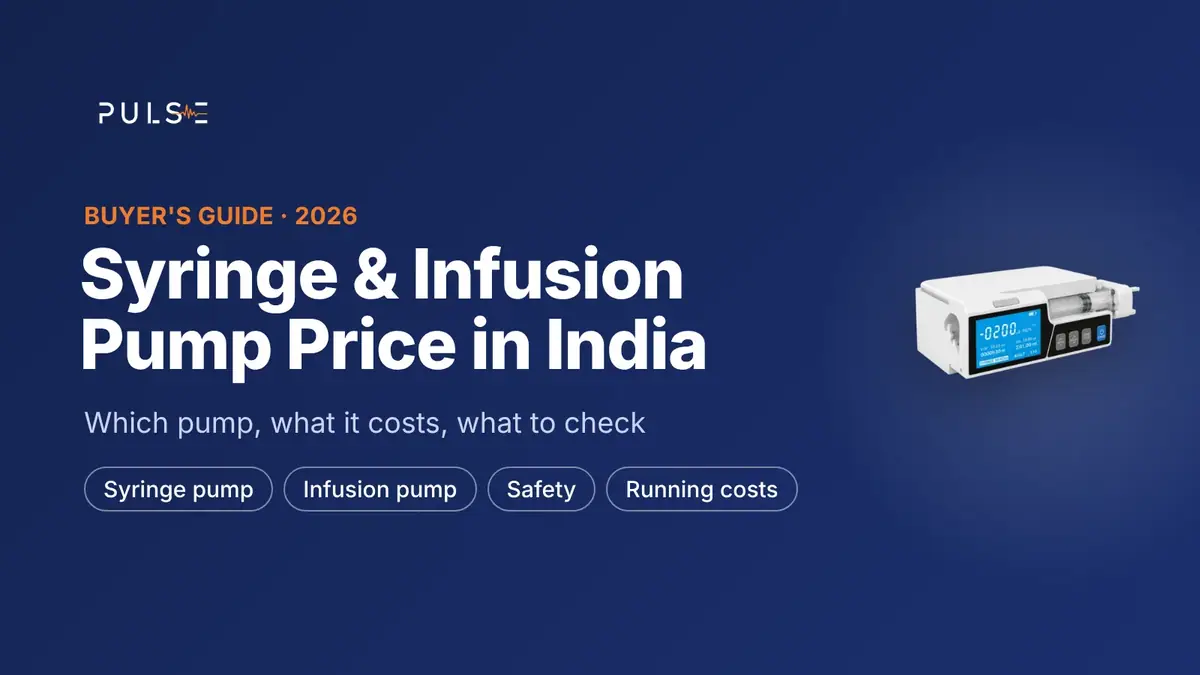
The Pulse Infusion Pump has a 4.3 inch colour touch screen, 0.1 to 1500 ml/h flow rate, ±5% accuracy, ml/h and drops/min modes, a KVO rate of 2.5 ml/h and about 5 hours of battery. The Pulse Syringe Pump takes 5 to 50 ml syringes, has a 3.8 inch touch display, ±2% accuracy and at least 8 hours of battery. Both come with installation, staff training and service.
How an Infusion Pump Works: Key Facts
- An infusion pump delivers fluids such as medicines and nutrients into the body in controlled amounts (US FDA).
- Volumetric (peristaltic) pumps use rollers that squeeze the tubing; syringe pumps use a piston that pushes the syringe plunger.
- Key settings are rate (ml/h), VTBI (volume to be infused) and KVO (keep vein open).
- Smart pumps warn when settings are outside safe limits for a drug.
- The US FDA received about 56,000 infusion pump problem reports from 2005 to 2009.
How an Infusion Pump Works: FAQs
How does an infusion pump work?
A volumetric infusion pump uses rollers that squeeze the tubing to move fluid from an IV bag at a set rate. A syringe pump uses a motor-driven piston to push a syringe plunger. The nurse sets the rate and volume on the screen.
What is the difference between an infusion pump and a syringe pump?
An infusion pump delivers larger volumes from an IV bag or bottle; a syringe pump delivers small, precise doses from a 5 to 50 ml syringe and is usually more accurate.
What does VTBI mean on an infusion pump?
Volume to be infused: the total amount the pump will give before it stops or alarms.
What is KVO on an infusion pump?
Keep vein open: a very slow flow, such as 2.5 ml/h, after the infusion ends so the cannula does not block.
What does an occlusion alarm mean?
The pump has sensed high pressure, usually because the line is blocked, clamped or kinked, or the cannula has a problem. Check the line before restarting.
Does Pulse make infusion and syringe pumps?
Yes. Pulse supplies an infusion pump (0.1 to 1500 ml/h, ±5%) and a syringe pump (5 to 50 ml syringes, ±2%), with installation, training and service. Message +91 90711 01108 for a quote.
Sources
- What is an infusion pump? (US FDA, content current as of 13 December 2017): definition, pump types and how they move fluid, smart pumps
- Infusion pumps (US FDA): programming by trained users, alarms, smart pumps, about 56,000 adverse event reports from 2005 to 2009
Related Reading