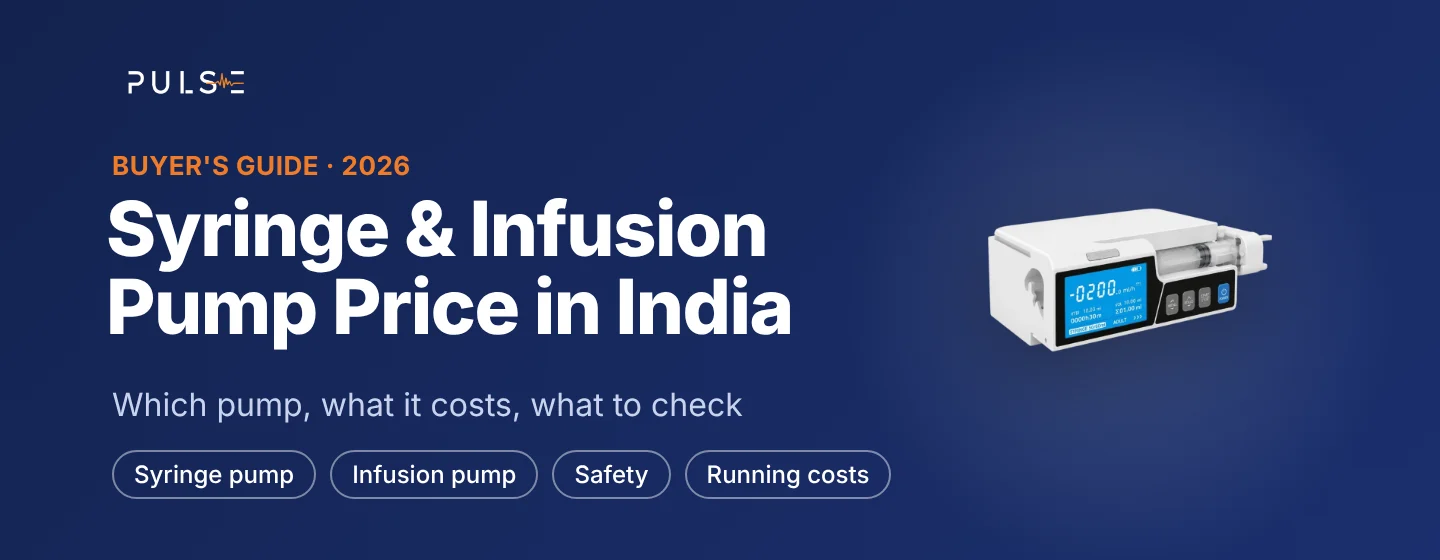
Syringe Pump and Infusion Pump Price in India: A Buyer's Guide
Syringe and infusion pumps look similar but do different jobs, and prices range from about Rs 12,000 to over Rs 1.9 lakh. This guide explains the price bands, the difference between the two, and how many a ward or ICU needs.
How much does a syringe or infusion pump cost in India? Bajaj Finserv's 2026 guides put basic single-channel syringe pumps at about Rs 12,000 to Rs 35,000 and volumetric infusion pumps at about Rs 22,000 to Rs 96,000. Multi-channel and specialised pumps can cost Rs 50,000 to Rs 1.95 lakh or more. Accuracy, safety alarms, battery life and service decide the price.
Syringe and Infusion Pump Price Ranges in India
The ranges below come from Bajaj Finserv's syringe pump guide (June 2026) and infusion pump guide (July 2026). They are indicative and usually exclude GST.
| Pump type | Typical price range | Used for |
|---|---|---|
| Single-channel syringe pump | Rs 12,000 to Rs 35,000 | Sedation, inotropes, insulin, small precise doses |
| Dual or multi-channel syringe pump | Rs 30,000 to Rs 60,000+ | Several drugs on one patient |
| High-end or specialised syringe pump | Rs 50,000 to Rs 1.95 lakh+ | Anaesthesia, neonatal and specialist use |
| Volumetric infusion pump | Rs 22,000 to Rs 96,000 | IV fluids, antibiotics, larger volumes |
| Enteral feeding pump | Rs 70,000 to Rs 85,000 | Tube feeding |
Syringe Pump vs Infusion Pump: Which Do You Need?
- Syringe pump: drives the plunger of a syringe, usually 5 to 60 ml. Best for small volumes that must be delivered very precisely, such as sedation, vasopressors, heparin or insulin.
- Volumetric infusion pump: moves fluid from a bag or bottle through an IV set. Best for larger volumes: fluids, antibiotics, blood products and nutrition.
Most ICUs, NICUs and OTs need both. Wards often start with infusion pumps and add syringe pumps for high-risk drugs.
What Drives the Price
1. Accuracy and flow range
Tighter accuracy and a wider flow range (from 0.1 ml/h for neonates and potent drugs up to 1,500 ml/h for fluids) cost more, and matter most for high-risk medicines.
2. Safety features
Occlusion (blockage) detection with adjustable pressure levels, air-in-line detection, near-empty and end-of-infusion alarms, and KVO (keep vein open) all raise the price, and all reduce risk.
3. Drug library and modes
Higher-end pumps store drug names and limits and offer dose-based modes. Basic pumps run by rate, volume and time.
4. Battery and build
Longer battery life matters for patient transfers and power cuts. Compact, light pumps are easier to mount on poles and stack at the bedside.
5. Consumables and service
A volumetric pump that needs its own branded IV sets can cost far more to run than the purchase price suggests. Check this, and check how quickly service is available.
Pulse Syringe and Infusion Pumps at a Glance
| Model | Key details |
|---|---|
| Syringe Pump | 1 to 1,500 ml/h (0.1 ml/h steps up to 100 ml/h); 5, 10, 20, 30 and 50 (60) ml syringes; accuracy within ±2%; KVO 2.5 ml/h; battery life not less than 8 hours; 3.8-inch touch display; 1.5 kg |
| Infusion Pump | 0.1 to 1,500 ml/h; accuracy ±5%; works with standard single-use IV sets from various brands; ml/h and drops/min modes; pressure detection; 4.3-inch colour touch screen; about 5 hours on battery |
How Many Pumps Do You Need?
As a starting point, plan at least one syringe pump and one infusion pump per ICU bed, and add more for patients on several infusions at once. On general wards, base the number on how many patients receive continuous infusions. Keep a few spare pumps for breakdowns and transfers.
Syringe Pump and Infusion Pump Price in India: Key Facts
- Basic single-channel syringe pumps in India cost about Rs 12,000 to Rs 35,000 (Bajaj Finserv, June 2026).
- Volumetric infusion pumps cost about Rs 22,000 to Rs 96,000 (Bajaj Finserv, July 2026).
- Specialised syringe pumps can cost Rs 50,000 to Rs 1.95 lakh or more.
- Syringe pumps suit small precise doses; infusion pumps suit larger volumes from bags or bottles.
- The Pulse Syringe Pump is accurate to within ±2% and runs at least 8 hours on battery.
Syringe Pump and Infusion Pump Price in India: FAQs
How much does a syringe pump cost in India?
Bajaj Finserv's June 2026 guide puts basic single-channel syringe pumps at about Rs 12,000 to Rs 35,000, dual or multi-channel pumps at about Rs 30,000 to Rs 60,000 or more, and high-end or specialised pumps at about Rs 50,000 to Rs 1.95 lakh or more.
How much does an infusion pump cost in India?
Bajaj Finserv's July 2026 guide puts volumetric infusion pumps at about Rs 22,000 to Rs 96,000, syringe infusion pumps at about Rs 17,500 to Rs 75,000, and enteral feeding pumps at about Rs 70,000 to Rs 85,000.
What is the difference between a syringe pump and an infusion pump?
A syringe pump pushes the plunger of a syringe (usually up to 50 or 60 ml) for small, very precise volumes, such as sedation, inotropes or insulin. A volumetric infusion pump moves fluid from a bag or bottle through an IV set, for larger volumes such as fluids, antibiotics and nutrition.
Which pump does an ICU need?
Most ICUs use both: syringe pumps for small-volume, high-risk drugs that need precise flow, and volumetric infusion pumps for fluids and larger infusions. Critically ill patients often need several pumps running at the same time.
What should I check before buying a syringe or infusion pump?
Check flow-rate range and accuracy, compatible syringe sizes or IV sets, occlusion (pressure) detection, air-in-line detection for volumetric pumps, KVO and bolus functions, battery life, alarm quality, and local service.
Do infusion pumps need special IV sets?
Some volumetric pumps only work with the maker's own IV sets, which raises running costs. Others, like the Pulse Infusion Pump, accept standard single-use IV sets from various brands. Ask about this before you buy.
How do I get a price for Pulse syringe or infusion pumps?
Message Pulse on WhatsApp at +91 90711 01108 with the model, the number of units and your city, and the team will share a quote.
Sources
- What is a Medical Syringe Pump? Types, Uses and Pricing (Bajaj Finserv, June 2026): syringe pump price ranges
- Infusion Pump: Types, Uses, Prices and Buying Guide (Bajaj Finserv, July 2026): infusion pump price ranges
- Pulse Syringe Pump and Infusion Pump product pages: machine details
Related Reading
- Hospital Equipment List by Department, with Prices in India
- Patient Monitor Price in India: 5 Para, 7 Para and ICU Monitors
- ICU Ventilator Price in India: What Drives the Cost
- ECG Machine Price in India: 3, 6 and 12 Channel Compared
- Medical Equipment Price List in India 2026
- Hospital Setup Checklist