HOME › Critical Care › Pulse Syringe Pump

Syringe Pump | Critical Care

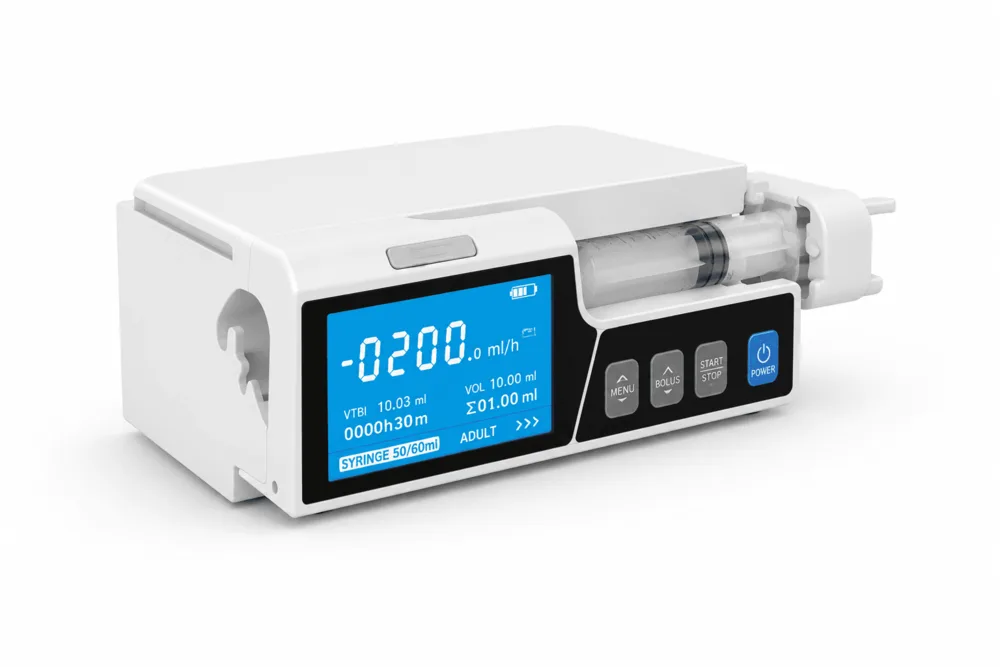
Pulse Syringe Pump

Precision syringe pump with 3.8" touch display supporting 5/10/20/30/50ml syringes, multiple infusion modes, ±2% accuracy, and minimum 8 hours battery life.

5ml–50ml Syringes 3.8" Touch Display 8hr Battery Life
Contact Us Request Brochure on WhatsApp

Syringe Pump: Standout Features

Rate Ranges by Syringe

5ml syringe 0.1–150 ml/h
10ml syringe 0.1–300 ml/h
20ml syringe 0.1–600 ml/h
30ml syringe 0.1–900 ml/h
50ml syringe 0.1–1500 ml/h

Technical Specifications

Volume Range 0.1ml–9999ml
Time Range 1min–99:59min
Display 3.8" Touch Display
Dimensions (W×D×H) 24.8×15.15×9.7cm
Weight 1.5 kg

You May Also Need

Infusion Pump Infusion Pump View Product → Anesthesia Workstation Anesthesia Workstation View Product → 5-Para Patient Monitor 5-Para Patient Monitor View Product →
Related guides: Critical Care Equipment Manufacturer in India · Medical Equipment Price List in India 2026: Ventilators, Dialysis Machines, Stents and More
← Back to Critical Care

Precision Dosing in Small Volumes

Some of the most critical drugs in a hospital are given in tiny volumes: insulin, sedatives, vasoactive medications. At that scale, a small error in rate is a large error in dose. This syringe pump is built around that reality, with occlusion detection sensitive enough to catch a blocked line early and a dose-rate accuracy that holds steady across the full range the ICU and OT actually use, not just the midpoint shown in a spec sheet.

It is also genuinely portable. Its battery is rated to outlast a typical patient transfer, and the compact body fits onto a standard IV pole or bed rail without extra brackets. For a ward or ICU that moves patients between departments several times a day, that portability is not a convenience feature, it is the difference between continuous dosing and a dangerous gap.
Got Questions?

Frequently Asked Questions

It delivers precise small-volume medication, such as insulin, sedatives, or vasoactive drugs, using 5ml to 50ml syringes.

Accuracy is within plus or minus 2 percent, holding steady across the full rate range the ICU and OT actually use.

Yes. Occlusion detection is sensitive enough to catch a blocked line early.

At least 8 hours, rated to outlast a typical patient transfer between departments.

Message Pulse on WhatsApp at +91 90711 01108, or use the Request Brochure button on this page.

Welcome to Pulse, How may I help you?
Hi!👋
Pulse AI Assistant