Ventilator Modes Explained: AC, SIMV, PSV, PRVC and More
A ventilator mode is the set of rules for how the machine gives each breath. This guide explains the common ICU modes in plain words, when each one is used, and what the main settings such as FiO2 and PEEP mean.
A ventilator mode decides who starts each breath and what the machine controls. In volume control the machine gives a set amount of air. In pressure control it pushes to a set pressure. The common ICU modes are assist control (AC), SIMV, pressure support (PSV) and PRVC. AC gives full support for every breath. PSV only helps breaths the patient starts.
What Is a Ventilator Mode?
Every breath from a ventilator follows three rules. What starts the breath, what the machine controls during it, and what ends it. A mode is a fixed set of these rules.
- Start (trigger): the patient starts the breath, or the machine starts it on a timer when the patient does not breathe in time.
- Control: the machine either sets the amount of air (volume) or the push (pressure).
- End (cycle): the breath stops at a set volume, a set time or when the air flow drops.
The machine senses the patient's effort as a small drop in pressure or a change in flow in the tubing. Source: Walter et al., Southern Medical Journal, 2018.
Volume Control vs Pressure Control
| Volume control | Pressure control | |
|---|---|---|
| What you set | Tidal volume (size of each breath) | Inspiratory pressure and time |
| What changes | Airway pressure rises if lungs are stiff | Breath size changes if lungs get stiffer or looser |
| Main plus | You know the breath size and minute ventilation | Pressure stays within the limit you set |
| Main watch-out | High pressure in stiff lungs | Breath size can fall without warning |
Sources: Southern Medical Journal, 2018; OpenAnesthesia.
Common Ventilator Modes in the ICU
| Mode | How it works | Often used for |
|---|---|---|
| CMV (continuous mandatory ventilation) | The machine starts and controls every breath. The patient does not need to try. | Deep sedation, coma or full paralysis |
| AC (assist control) | The patient or the timer can start a breath. Every breath gets full support. | Most patients when they first go on the ventilator |
| SIMV (synchronised intermittent mandatory ventilation) | A set number of full breaths, timed with the patient. Extra breaths are the patient's own, often with pressure support. | Weaning in some ICUs |
| PSV (pressure support) | No set rate. The patient starts every breath and the machine adds a fixed push. | Weaning and breathing trials |
| PRVC (pressure-regulated volume control) | The machine changes the pressure breath by breath to reach a set volume. | Lightly sedated patients and stiff or tight lungs |
| CPAP | A steady pressure through the whole breath. The patient does all the breathing. | Patients breathing well on their own |
| APRV | A high steady pressure with short, timed releases. The patient can breathe all the time. | A rescue option in some patients with ARDS |
Sources: OpenAnesthesia (updated 22 Dec 2025); Southern Medical Journal, 2018; Daoud, Annals of Thoracic Medicine, 2007 for APRV.
PRVC goes by other names on different machines, such as VC+ or adaptive pressure ventilation. The name on the screen can differ, but the idea is the same.
AC vs SIMV: The Key Difference
In AC, every breath gets full support, even the extra breaths the patient starts. In SIMV, only the set number of breaths get full support. Any extra breaths are the patient's own effort, unless pressure support is added to them.
So a patient who breathes fast on AC gets many full breaths. On SIMV, the same patient does more of the work.
Main Ventilator Settings in Simple Words
- Tidal volume: the size of each breath. For lung protection, OpenAnesthesia lists 6 mL per kg of predicted body weight.
- Rate: the number of set breaths per minute.
- PEEP: a small pressure kept in the lungs at the end of each breath, so they do not collapse. A common start is 5 cm H2O.
- FiO2: the share of oxygen in each breath, from 21% (room air) to 100%.
- Pressure support: the extra push added to breaths the patient starts.
| Setting | Lung-protective start (OpenAnesthesia) |
|---|---|
| Tidal volume | 6 mL/kg predicted body weight |
| PEEP | At least 5 cm H2O |
| FiO2 | Adjusted to keep SpO2 at 88 to 95% |
| Plateau pressure | Below 30 cm H2O |
Source: OpenAnesthesia. The doctor sets the actual values for each patient. This table is not a treatment plan.
What Is FiO2 on a Ventilator?
FiO2 means fraction of inspired oxygen. Room air is 21% oxygen. A ventilator can give anything from 21% to 100%, shown as 0.21 to 1.00 (eCampusOntario).
Teams often start at a high FiO2 when a patient first goes on the ventilator, then bring it down. High FiO2 is linked to oxygen toxicity, though it is generally thought safe for a short time. The University of Iowa course notes that a goal of FiO2 at or below 50% is sometimes used, with PEEP raised to help (University of Iowa).
Which Modes Are Used for Weaning?
Weaning means helping the patient breathe on their own again. Long ventilation raises the risk of weak muscles, lung injury and pneumonia, so teams test readiness early.
OpenAnesthesia describes a daily spontaneous breathing trial: about 30 minutes on low pressure support with little sedation, while staff watch oxygen and blood pressure. A rapid shallow breathing index (breathing rate divided by tidal volume) below 105 suggests the patient may be ready to come off (OpenAnesthesia).
The Pulse ICU Ventilator
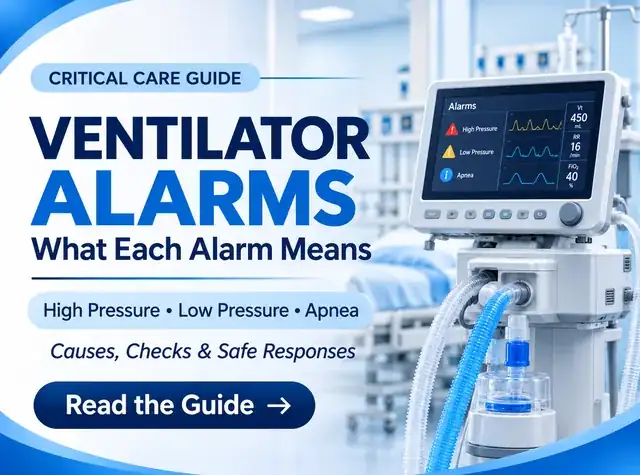
The Pulse ICU ventilator offers invasive modes including VCV, PCV, SIMV-V, SIMV-P, CPAP/PSV, PRVC, SIMV-PRVC and APRV. It also has non-invasive modes, and works for neonates, children and adults. See the full list and specifications on the product page. For prices, read our ICU ventilator price guide. For what each alarm means, see ventilator alarms explained.
Ventilator Modes: Key Facts
- A mode sets what starts each breath, what is controlled and what ends it.
- Volume control sets breath size; pressure control sets the push.
- AC gives full support to every breath; SIMV only to the set breaths.
- Pressure support helps only breaths the patient starts, with no set rate.
- Room air is 21% oxygen; a ventilator can give 21% to 100% FiO2.
Ventilator Modes: FAQs
What are the main modes of a ventilator?
The common ICU modes are assist control (AC), SIMV, pressure support (PSV), PRVC, CPAP and APRV. Each can use volume control or pressure control.
What is the difference between AC and SIMV?
In AC every breath gets full support, including breaths the patient starts. In SIMV only the set number of breaths get full support, and extra breaths are the patient's own.
What is FiO2 on a ventilator?
FiO2 is the share of oxygen in each breath. Room air is 21%, and a ventilator can give from 21% to 100%.
What is PEEP on a ventilator?
PEEP is a small pressure kept in the lungs at the end of each breath so they do not collapse. A common starting value is 5 cm H2O.
Which ventilator mode is used for weaning?
Pressure support is widely used for breathing trials, and SIMV is used for weaning in some ICUs. A typical trial is about 30 minutes on low pressure support.
What is PRVC mode?
PRVC stands for pressure-regulated volume control. The machine changes the pressure breath by breath to reach a set breath size.
Does Pulse make ICU ventilators?
Yes. The Pulse ICU ventilator has invasive and non-invasive modes for neonates, children and adults. Message +91 90711 01108 for a quote.
Sources
- Basics of Mechanical Ventilation in the ICU (OpenAnesthesia, updated 22 Dec 2025): modes, starting settings, weaning trial
- Invasive Mechanical Ventilation (Walter, Corbridge and Singer, Southern Medical Journal, 2018): how breaths are started, controlled and ended; PRVC
- Airway pressure release ventilation: what do we know? (Daoud, Annals of Thoracic Medicine, 2007)
- FiO2 (University of Iowa ventilator course) and Supplemental oxygen and mechanical ventilation (eCampusOntario)
Related Reading