Ventilator Alarms Explained: What Each Alarm Means
A ventilator alarm tells the ICU team that something has changed in the patient, the tubing or the machine. This guide explains the common alarms, what usually causes them, and the safe order of checks.
A high pressure alarm usually means something is blocking the air, such as secretions, a kinked tube or the patient biting or coughing. A low pressure or low volume alarm usually means air is escaping, such as a disconnection or cuff leak. Check the patient first. If they are getting worse, disconnect and bag on 100% oxygen.
What Ventilator Alarms Do
A ventilator watches pressure, volume, breathing rate and oxygen on every breath. The team sets upper and lower limits for each. When a reading goes past a limit, the ventilator sounds an alarm and shows a message. For how the machine works, see our ICU ventilator guide.
Common Alarms and Their Causes
| Alarm | What it usually means | Common causes |
|---|---|---|
| High pressure | Air is meeting a block or a stiff lung | Secretions, kinked tube, biting, coughing, water in the tubing, bronchospasm, pneumothorax |
| Low pressure | Air is escaping | Disconnection, loose connection, tubing leak, cuff leak |
| Low exhaled volume | Less air is coming back | Cuff leak, loose tubing, exhalation valve problem |
| Low minute volume | Too little air per minute | Small breaths, apnea, large leak |
| Apnea (low rate) | No breath for a set time | No breathing effort, heavy sedation, trigger or sensor fault |
| High rate | Breathing too fast | Pain, anxiety, low oxygen, the machine triggering itself |
| Low oxygen supply | Gas supply problem | Empty cylinder, wall gas failure, hose off |
These causes come from a 2026 respiratory therapy study guide and a ventilator maker's alarm guide.
Equipping an ICU?Get a written quote, brochure or demo from the Pulse team.
The Safe Order of Checks
- Look at the patient and the breathing tube first.
- Check the oxygen, air and power supply.
- Follow the tubing from the patient to the machine. Look for kinks, leaks and water.
- Drain any water in the tubing away from the patient.
- Compare the pressure and volume readings with the limits.
- Put the patient back on the ventilator only when it is working safely.
Do not just silence the alarm. If the patient is getting worse and the cause is not clear, disconnect and breathe for the patient with a bag on 100% oxygen.
DOPE: When a Patient Suddenly Gets Worse
- D, Displacement: the tube has moved out or too far in.
- O, Obstruction: mucus, a kink or the patient biting the tube.
- P, Pneumothorax: air around the lung, with rising pressures and missing breath sounds on one side.
- E, Equipment: a disconnection, a ventilator fault or lost gas supply.
Peak vs Plateau Pressure
Peak pressure goes up when the airway is blocked or the lung is stiff. Plateau pressure, measured with a short pause at the end of a breath, goes up only when the lung is stiff. So a high peak with a normal plateau points to a blocked airway, such as secretions or a kink. If both go up, think of a stiff lung, fluid or a pneumothorax. The guide suggests keeping plateau pressure at or below 30 cm H2O.
The monitor helps too. See our EtCO2 and patient monitor normal values guides.
Avoid Alarm Fatigue
We suggest setting limits for each patient, not leaving factory limits in place, and reviewing them at each shift. Too many false alarms teach staff to ignore them. A good ventilator should flag real problems without sounding during routine care.
The Pulse ICU Ventilator
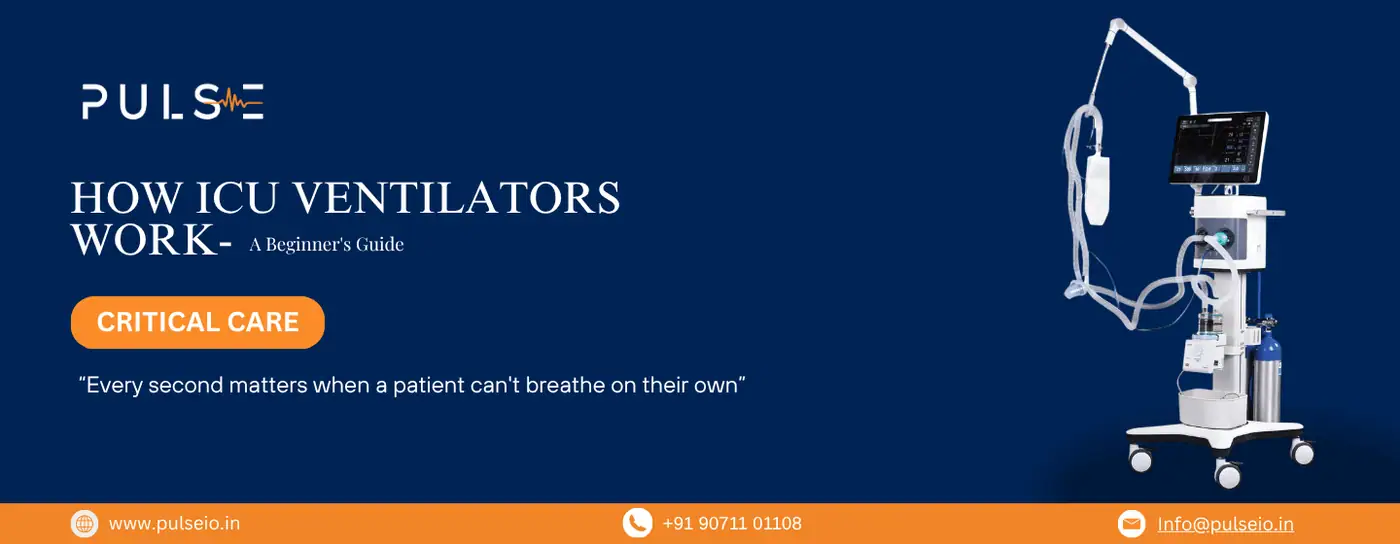
The Pulse ICU ventilator supports neonatal, paediatric and adult patients. It uses turbine technology and an 18.5 inch touchscreen, with invasive and non-invasive modes. Its alarms are tuned to flag real problems such as high pressure or disconnection, not routine suction or patient movement. Pulse critical care devices are CDSCO cleared and CE marked, made under ISO 13485. See our ICU ventilator price guide.
Ventilator Alarms: Key Facts
- High pressure alarms usually mean a block or a stiff lung.
- Low pressure and low volume alarms usually mean a leak or disconnection.
- Check the patient first, then gas and power, then the tubing.
- If the patient is getting worse, disconnect and bag on 100% oxygen.
- DOPE stands for Displacement, Obstruction, Pneumothorax, Equipment.
Ventilator Alarms: FAQs
What causes a high pressure alarm on a ventilator?
Secretions, a kinked tube, the patient biting or coughing, water in the tubing, bronchospasm or a pneumothorax.
What causes a low pressure alarm on a ventilator?
Air is escaping, usually from a disconnection, a loose connection, a tubing leak or a leak around the cuff.
What does an apnea alarm mean?
The ventilator has not detected a breath for a set time. Causes include no breathing effort, heavy sedation or a trigger or sensor fault.
What is the first thing to do when a ventilator alarms?
Look at the patient and the breathing tube. If the patient is getting worse and the cause is not clear, disconnect and bag on 100% oxygen.
What does DOPE stand for?
Displacement, Obstruction, Pneumothorax and Equipment: the four checks when a ventilated patient suddenly gets worse.
Does Pulse supply ICU ventilators?
Yes. The Pulse ICU ventilator supports neonatal, paediatric and adult patients with invasive and non-invasive modes. Message +91 90711 01108 for a quote.
Sources
- Ventilator alarms and circuit troubleshooting (Open Exam Prep, NBRC study guide, updated June 2026): alarm causes, safety sequence, DOPE, peak vs plateau
- Ventilator alarms (Medtronic, Living with a Vent, undated): high and low pressure, rate and volume alarm causes
- Mechanical ventilator alarms (Tracheostomy Education, undated): alarm types
Related Reading