ICU Ventilator Price in India: What Drives the Cost
Two ICU ventilators can differ in price by more than Rs 10 lakh. This guide explains the typical price ranges in India, what actually drives the cost, and what to ask for so that two quotes can be compared fairly.
How much does an ICU ventilator cost in India? Published market guides put ICU and critical care ventilators at roughly Rs 7 lakh to Rs 22 lakh or more, before taxes. Transport ventilators usually cost Rs 1.5 lakh to Rs 5.5 lakh, and non-invasive (BiPAP) units Rs 1 lakh to Rs 3 lakh. The final price depends mainly on patient range, ventilation modes, monitoring, battery backup and service terms.
ICU Ventilator Price Ranges in India
The ranges below come from published Indian market price guides. They are indicative, exclude GST, and change with brand, configuration and order size.
| Ventilator type | Typical price range | Typical use |
|---|---|---|
| ICU / critical care ventilator | Rs 7 lakh to Rs 22 lakh+ | Long-term invasive and non-invasive ventilation in the ICU |
| Transport / portable ventilator | Rs 1.5 lakh to Rs 5.5 lakh | Moving patients within or between hospitals, ambulances |
| Non-invasive (BiPAP) ventilator | Rs 1 lakh to Rs 3 lakh | Mask-based support, step-down and home care |
Government buying shows the same upper band. A GeM tender for the ESIC Model Hospital in Guwahati (bid GEM/2026/B/7696585, closing August 2026) was valued at Rs 1.90 crore for 10 ICU ventilators, which works out to roughly Rs 19 lakh per unit if the value covers all ten.
What Drives the Price of an ICU Ventilator
1. Patient range
A ventilator that safely covers neonates, pediatric and adult patients needs a much wider tidal volume range and finer control than an adult-only unit. It costs more up front, but it saves buying a separate neonatal ventilator later.
2. Ventilation modes
Basic units offer a few volume and pressure modes. ICU-grade machines add modes such as SIMV, PRVC, APRV and dual-control ventilation, plus non-invasive ventilation and high-flow oxygen therapy in the same device. Each added capability raises the price, so pay only for modes your clinicians will use.
3. Drive technology
A turbine-driven ventilator generates its own airflow, so it does not depend on a hospital compressed-air supply. That matters for smaller hospitals without central medical air, and for moving the ventilator between wards.
4. Screen, monitoring and alarms
Larger touchscreens, waveform and loop displays, and well-tuned alarms add cost. Alarm behaviour matters more than it looks: a unit that raises false alarms during routine suction or patient movement trains staff to ignore warnings.
5. Battery backup and power handling
Indian ICUs do not always run on clean, constant mains power. Longer battery backup and good handling of voltage swings raise the price, but protect the patient during outages.
6. Warranty, service and training
Two quotes for the same model can differ widely depending on warranty length, whether installation and staff training are included, and how quickly a service engineer can reach your site. Read more in our guide on why after-sales service matters.
Costs to Budget Beyond the Purchase Price
- Consumables: breathing circuits, filters, humidification and sensors, replaced regularly
- Annual maintenance: an AMC or CMC once the warranty ends
- Training: for doctors, nurses and respiratory therapists on each mode you plan to use
- Downtime: the cost of a bed out of service if a part is slow to arrive
A slightly higher purchase price with fast local service is often cheaper over five years than the lowest quote with slow support.
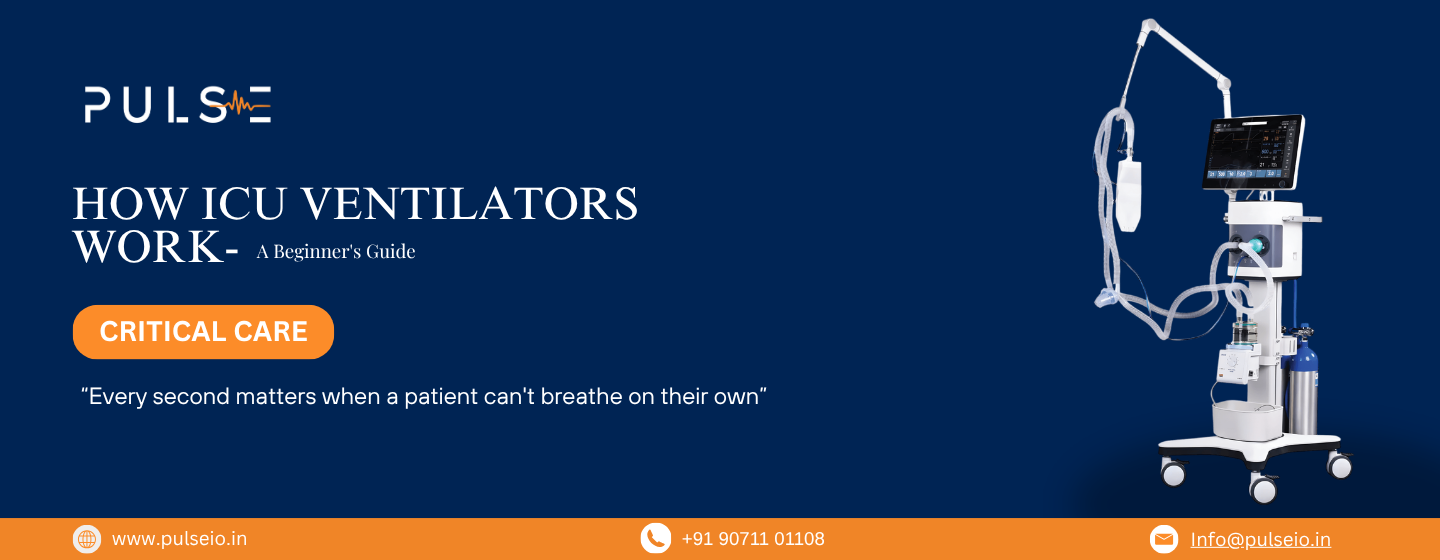
The Pulse ICU Ventilator at a Glance
The Pulse ICU Ventilator is built for hospitals that want one machine across patient groups:
| Specification | Detail |
|---|---|
| Patients | Neonate, pediatric and adult |
| Technology | Turbine-driven |
| Display | 18.5-inch touchscreen |
| Therapies | Invasive, non-invasive and high-flow oxygen therapy |
| Invasive modes | VCV, PCV, SIMV-V, SIMV-P, CPAP/PSV, PRVC, SIMV-PRVC, DualVent, APRV and more |
| Tidal volume | 2 ml to 4000 ml |
| PEEP | OFF, 1 to 50 cmH2O |
| Oxygen concentration | 21% to 100% |
How to Get an Accurate Quote
Whether you run a small clinic ICU or a large hospital, share these details so that every supplier quotes the same thing:
- Number of units and delivery location
- Patient mix: neonatal, pediatric, adult
- Modes and therapies you need, including non-invasive and high-flow oxygen
- Whether central medical air is available at the bedside
- Warranty, AMC, installation and training you expect in the price
Then compare quotes on the full five-year cost, not just the purchase price.
Frequently Asked Questions
How much does an ICU ventilator cost in India?
Published market guides put ICU and critical care ventilators at roughly Rs 7 lakh to Rs 22 lakh or more, before taxes. Transport ventilators are usually Rs 1.5 lakh to Rs 5.5 lakh, and non-invasive (BiPAP) units Rs 1 lakh to Rs 3 lakh.
Why do ICU ventilator prices vary so much?
Price depends on the patient range it supports (neonatal to adult), the number of ventilation modes, the drive technology, the screen and monitoring, battery backup, and the service and warranty terms included in the quote.
What costs should a hospital budget for beyond the purchase price?
Breathing circuits, filters and sensors, an annual maintenance contract after warranty, staff training, and the cost of downtime if the unit fails and spare parts are slow to arrive.
Is a cheaper ventilator suitable for small clinics?
Both small clinics and large hospitals should buy for the patients they actually treat. A unit covering neonatal, pediatric and adult patients avoids buying separate machines later, which often costs more overall.
How do I get a price for the Pulse ICU Ventilator?
Message Pulse on WhatsApp at +91 90711 01108 with the number of units, your patient mix and installation site, and the team will share a quote.