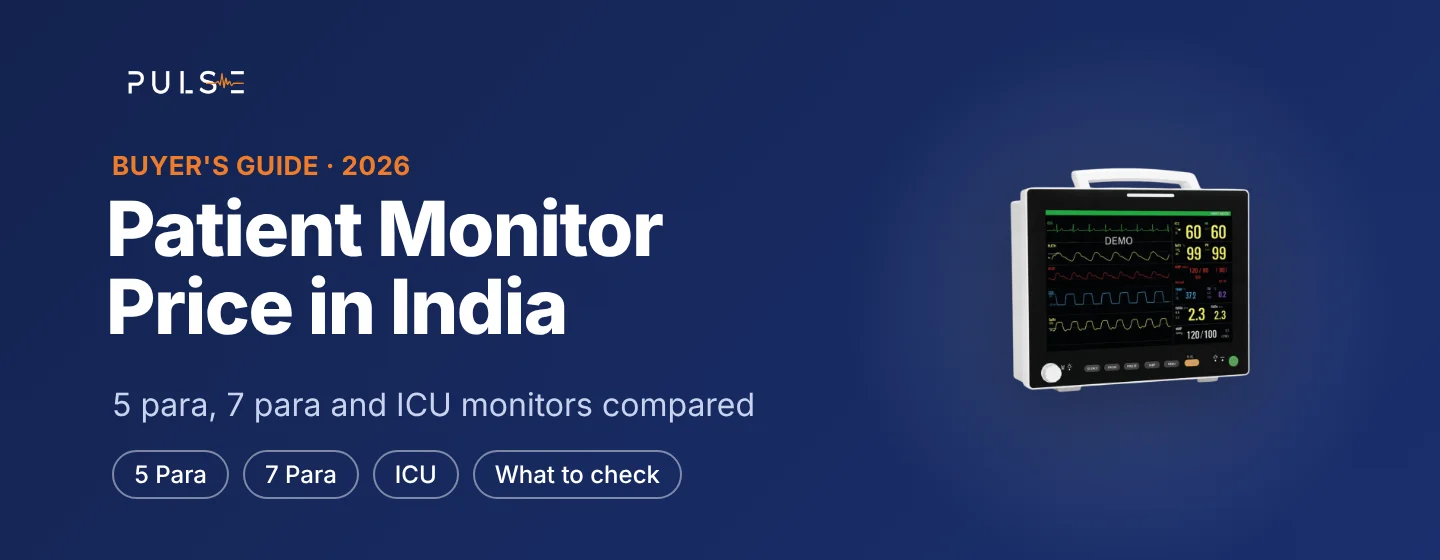
Patient Monitor Price in India: 5 Para, 7 Para and ICU Monitors
Patient monitors in India range from under Rs 20,000 to over Rs 2 lakh. This guide explains the price bands, what 5 para and 7 para actually measure, and which monitor fits a ward, HDU or ICU.
How much does a patient monitor cost in India? Published listings in 2025 and 2026 put basic 5-para monitors at about Rs 19,000 to Rs 40,000, mid-range 12-inch multipara monitors at about Rs 40,000 to Rs 75,000, and advanced ICU monitors with EtCO2, IBP or cardiac output at about Rs 1 lakh to Rs 2.2 lakh or more, usually before GST. The number of parameters, screen, alarms and service decide where a monitor falls.
Patient Monitor Price Ranges in India
These ranges are drawn from published Indian listings (sources at the end). They are indicative and change with brand, configuration, accessories and order size.
| Monitor type | Typical price range | Best suited to |
|---|---|---|
| Basic 5 para monitor | Rs 19,000 to Rs 40,000 | Wards, nursing homes, clinics, recovery |
| Mid-range 12-inch multipara monitor | Rs 40,000 to Rs 75,000 | HDU, step-down, OT recovery, emergency |
| Advanced ICU monitor (EtCO2, IBP, cardiac output) | Rs 1 lakh to Rs 2.2 lakh+ | ICU, ventilated patients, cardiac and surgical ICUs |
For example, Bajaj Finserv's multipara monitor guide lists individual models from about Rs 30,000 up to Rs 2.2 lakh, and online medical stores list 5 para monitors from under Rs 30,000.
5 Para vs 7 Para: What the Numbers Mean
"Para" is short for parameter, one thing the monitor measures.
- 5 para: ECG, SpO2, NIBP, respiration and temperature, with heart or pulse rate shown alongside. This covers most ward and recovery patients.
- 7 para: the same five plus two more, most often EtCO2 (carbon dioxide in exhaled breath) and IBP (invasive, beat-by-beat blood pressure) or cardiac output. These matter for ventilated, surgical and unstable patients.
For a deeper comparison, read 5-Para vs 7-Para Patient Monitor: Which Does Your Ward Actually Need?
What Drives the Price of a Patient Monitor
1. Parameters and modules
Each added measurement, especially EtCO2 and IBP, adds sensors, software and accessories. Modular monitors that let you add parameters later cost more up front.
2. Screen and usability
A 12-inch or larger high-resolution screen, touch control and clear waveforms make a monitor easier to read across a busy ward.
3. Alarms
Good monitors use graded (high, medium, low) audio and visual alarms with adjustable limits. Alarms that go off for every movement lead to alarm fatigue.
4. Patient range and NIBP modes
Support for adult, paediatric and neonatal blood pressure modes lets one model serve every ward.
5. Battery, protection and connectivity
Built-in battery backup, defibrillator and electrosurgery (HF knife) protection, data storage and central monitoring all add cost, and all matter in ICU and OT use.
6. Accessories, warranty and service
Quotes often differ in which probes and cuffs are included, how long the warranty is, and how quickly a service engineer can reach you. See why after-sales service matters.
Costs to Budget Beyond the Purchase Price
- SpO2 probes and NIBP cuffs: in adult, paediatric and neonatal sizes
- ECG leads and electrodes: leads wear out; electrodes are single-use
- EtCO2 sampling lines and IBP transducers: for 7 para monitors
- Central monitoring station: if you want every bed visible at the nursing station
- Annual maintenance: an AMC or CMC once the warranty ends
Pulse Patient Monitors at a Glance
| Model | Key details | Good for |
|---|---|---|
| 5-Para Patient Monitor | 12.1-inch colour TFT display; ECG (3/5 lead), SpO2, NIBP, PR/HR, respiration, two temperature channels; ST-segment analysis; pacemaker detection; 3-level alarms; defibrillator and HF knife protection; built-in battery | Wards, HDU, OT recovery, emergency, general ICU beds |
| 7-Para Patient Monitor | 12.1-inch colour display; ECG, SpO2, NIBP (adult, paediatric, neonatal), respiration, temperature, EtCO2 and cardiac output; options for IBP, touch screen, printer and central monitoring; battery backup | ICU, ventilated and surgical patients |
How to Choose: A Quick Guide
- General wards, nursing homes, recovery: a 5 para monitor
- HDU, emergency, OT: a 12-inch 5 para monitor with strong alarms and battery backup
- ICU with ventilated patients: a 7 para monitor with EtCO2, plus IBP for unstable or cardiac patients
Whether you equip one clinic bed or a full ICU, buying the same model across wards simplifies training, spares and accessories.
Patient Monitor Price in India: Key Facts
- Basic 5 para monitors in India cost about Rs 19,000 to Rs 40,000.
- Mid-range 12-inch multipara monitors cost about Rs 40,000 to Rs 75,000.
- Advanced ICU monitors with EtCO2, IBP or cardiac output cost about Rs 1 lakh to Rs 2.2 lakh or more.
- A 5 para monitor measures ECG, SpO2, NIBP, respiration and temperature.
- A 7 para monitor usually adds EtCO2 and IBP or cardiac output.
Patient Monitor Price in India: FAQs
How much does a patient monitor cost in India?
Published listings in 2025 and 2026 put basic 5-para monitors at about Rs 19,000 to Rs 40,000, mid-range 12-inch multipara monitors at about Rs 40,000 to Rs 75,000, and advanced ICU monitors with EtCO2, IBP or cardiac output at about Rs 1 lakh to Rs 2.2 lakh or more, usually before GST.
What are the 5 parameters in a 5 para monitor?
A 5 para monitor measures ECG (heart rhythm), SpO2 (blood oxygen), NIBP (non-invasive blood pressure), respiration rate and temperature. Pulse or heart rate is shown alongside. The Pulse 5-Para Monitor also offers two temperature channels and ST-segment analysis.
What is the difference between a 5 para and 7 para monitor?
A 7 para monitor adds two more measurements to the five basic ones, most often EtCO2 (carbon dioxide in exhaled breath) and IBP (invasive blood pressure) or cardiac output. These matter for ventilated, surgical and unstable ICU patients. For wards, step-down and recovery beds, a 5 para monitor is usually enough.
Which patient monitor is best for an ICU?
For ventilated or unstable ICU patients, choose a monitor with EtCO2 and IBP, which usually means a 7 para or modular monitor with central monitoring. For general ICU beds, HDU and recovery, a good 5 para monitor with reliable alarms and battery backup is often sufficient.
What should I check before buying a patient monitor?
Check the parameters you need, screen size and readability, alarm quality, NIBP modes for adult, paediatric and neonatal patients, battery backup, defibrillator protection, central monitoring support, accessory costs and local service.
What are the running costs of a patient monitor?
Mainly accessories that wear out or are single-use: SpO2 probes, NIBP cuffs in different sizes, ECG leads and electrodes, temperature probes, and for 7 para monitors EtCO2 sampling lines and IBP transducers. Budget for an AMC after the warranty.
How do I get a price for a Pulse patient monitor?
Message Pulse on WhatsApp at +91 90711 01108 with the model (5 or 7 para), the number of beds and your city, and the team will share a quote.
Sources
- Multipara Parameter Patient Monitor Machine: Types and Prices (Bajaj Finserv, September 2025): listed model prices from about Rs 30,000 to Rs 2.2 lakh
- Five Para Patient Monitor listing (Medikabazaar, accessed October 2026): online selling price of a 5 para monitor
- 5 Para Patient Monitor, 12.1 inch (IndiaMART listing, accessed October 2026): entry price for a 12.1-inch 5 para monitor
- Pulse 5-Para and 7-Para Patient Monitor product pages: machine details
Related Reading
- Hospital Equipment List by Department, with Prices in India
- ICU Bed Price in India: Manual, 3 Function and 5 Function Electric
- 5-Para vs 7-Para Patient Monitor: Which Does Your Ward Actually Need?
- ECG Machine Price in India: 3, 6 and 12 Channel Compared
- ICU Ventilator Price in India: What Drives the Cost
- Medical Equipment Price List in India 2026
- Critical Care Equipment Manufacturer in India