Medical Equipment Distributors in India: Why Hospitals Go Direct
Search "medical equipment distributors in India" or "medical equipment dealers near me" and you will find hundreds of listings. What that search does not show you is how the traditional dealer network actually works underneath, and why a growing number of hospitals are bypassing it entirely.
How the Traditional Distribution Chain Actually Works
For decades, medical equipment in India moved through a layered structure: a national distributor sells to regional stockists, who sell to city-level dealers, who finally deliver to the hospital. Each layer exists to solve a real logistics problem. India's hospital sector is enormously fragmented, with over 70% of hospitals operating fewer than 30 beds, spread across geography that a single national sales force struggles to cover directly.
But every layer between the manufacturer and your hospital also adds a markup, a communication gap, and a point where accountability can get diffused. If your ventilator's alarm sensor fails, is that the city dealer's problem, the regional stockist's, or the manufacturer's? In a layered chain, the honest answer is often "unclear." That is exactly the kind of ambiguity a hospital biomedical team does not have time for during an equipment failure.
The Friction This Creates for Buyers
A few specific problems come up repeatedly in this model:
- Price variation and opacity. Because stock and pricing depend on regional and territory-level dealer allocations, the same equipment can carry meaningfully different prices depending on which dealer you happen to reach — with limited visibility into whether that price is actually competitive.
- Stock availability tied to territory, not need. A dealer's inventory reflects their allocated territory stock, not necessarily what your hospital needs right now, which can mean waiting on equipment that technically exists in the country but isn't in your dealer's warehouse.
- Thin, inconsistent service accountability. Distributors typically operate on relatively thin margins, which limits how much service infrastructure — trained technicians, spare parts stock, rapid response — they can realistically maintain per equipment category.
- Documented integrity concerns in parts of the industry. It's worth naming plainly: opaque, high-margin distribution structures have historically created conditions for unethical incentive practices between distributors and purchasing decision-makers in some corners of the industry — a structural risk that shortens as fewer intermediary layers sit between manufacturer and buyer.
Every layer in a distribution chain exists to solve a real problem. But each one also adds distance between you and the company that actually knows how the equipment was built.
The Shift Already Underway
This is not just a Pulse talking point. It is a documented industry trend. Digital procurement platforms are actively dismantling the bottlenecks that made medical equipment sourcing slow and opaque. This is shifting hospitals away from vendor dependency and unpredictable price variation, toward more transparent, direct relationships. Distributors themselves are evolving, increasingly repositioning as service partners rather than the primary sales channel, as OEMs gain direct reach to hospitals that a decade ago they could only access through layered networks.
What "One Manufacturer, Seven Categories" Actually Solves
Most hospitals don't source from a single dealer — they typically have a different distributor relationship for critical care equipment, another for renal consumables, another for hospital furniture, another for surgical instruments. That's not one dealer relationship to manage; it's several, each with its own pricing, service terms, and escalation path.
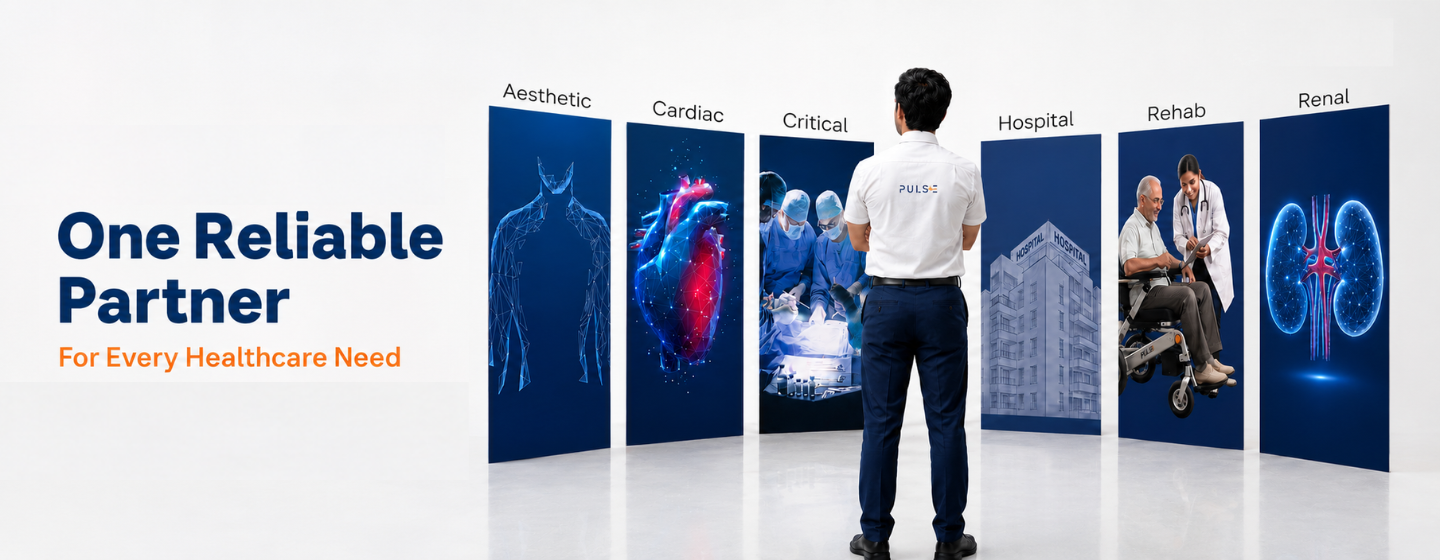
A horizontal OEM that manufactures across Critical Care, Renal Care, Cardiac Care, Aesthetics, Rehabilitation, Hospital Setup, and Surgical collapses that into one relationship. It spans categories that would otherwise need five or six separate dealer contacts. That is the practical value of "going direct" at scale: not just cutting out one middleman on one purchase, but bringing an entire hospital's equipment sourcing into a single accountable line.
| Traditional Multi-Dealer Model | Direct-from-OEM Model |
|---|---|
| Separate dealer per equipment category | One manufacturer across all categories |
| Price varies by territory/dealer allocation | Consistent, direct pricing |
| Service quality depends on dealer's margin and capacity | Service backed directly by the manufacturer |
| Accountability can be unclear across layers | One company designed, built, and supports the equipment |
| Stock tied to regional dealer inventory | Direct visibility into manufacturer stock and lead times |
What "Near Me" Actually Should Mean
"Medical equipment dealers near me" reflects a real, reasonable concern — hospitals want a vendor who can actually reach their facility quickly when something needs servicing, not just a name on a website. That concern is legitimate regardless of whether you're buying from a local dealer or a manufacturer with national reach. The right question isn't "is this vendor physically nearby" but "does this vendor have a service network and documented response commitment that reaches my facility" — a manufacturer with a pan-India service network and a defined response-time commitment in writing solves the actual underlying need better than proximity alone.
The Bottom Line
Distributors and dealers are not going away. For many product categories and hospital sizes, they remain a practical and legitimate way to source equipment. But the friction they can introduce, price opacity, diffused accountability, thinner service margins, is real. That is exactly why more hospitals are evaluating direct-from-manufacturer relationships, especially where one OEM can cover multiple equipment categories at once.
No more juggling vendors. No more disappearing service. No more waiting weeks. Pulse is a horizontal MedTech OEM brand — one manufacturer, one accountable relationship, across all seven categories your hospital needs to source, with a pan-India service network standing behind every product we build.
See Why Hospitals Choose Pulse →