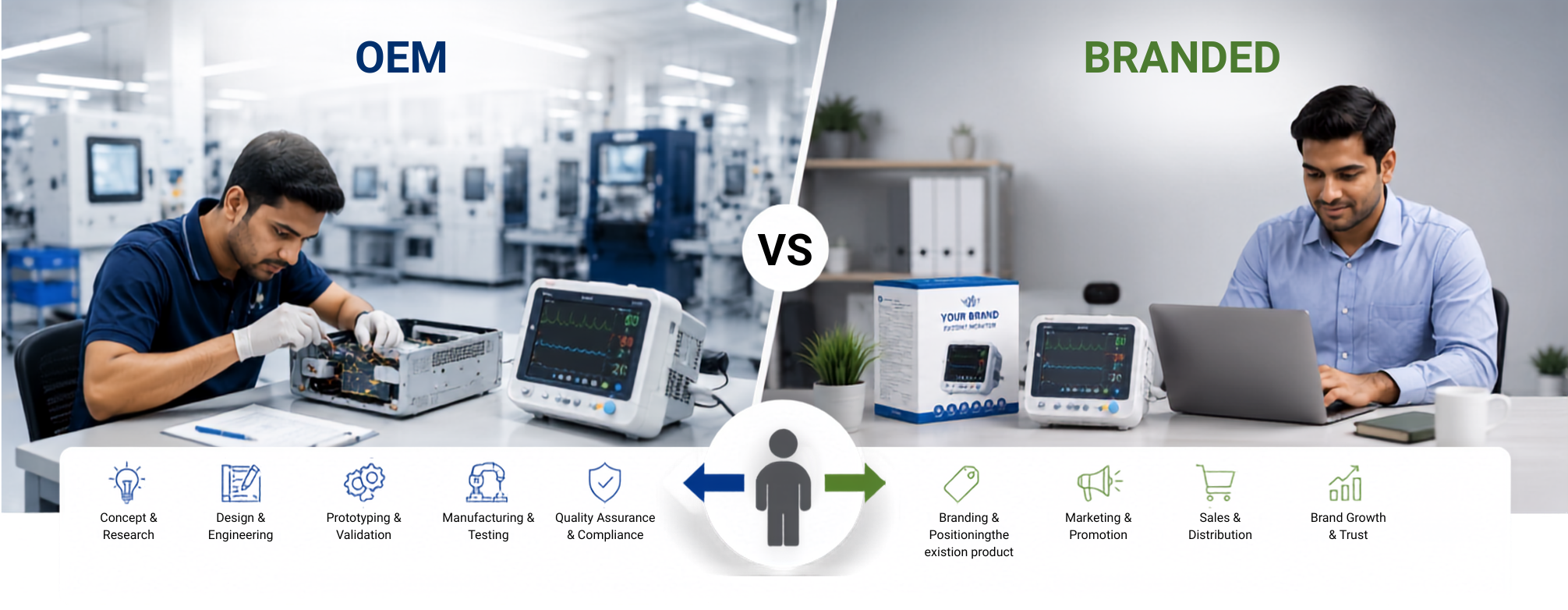
OEM vs Branded Medical Equipment Manufacturing
If you've sat across the table from a vendor and heard the word "OEM" used like everyone already agrees on what it means, you're not alone. It's one of the most misused terms in hospital procurement — and the confusion isn't harmless.
This isn't a sales pitch dressed up as an explainer. It's the breakdown we wish more procurement teams had before they signed their last equipment contract.
What "OEM" Actually Means — And Why Hospitals Get It Wrong
OEM stands for Original Equipment Manufacturer. In its cleanest form, it means the company that designs and builds the device is the same company whose name is on it. No middleman rebranding someone else's factory output, no ambiguity about who's accountable when something goes wrong.
But the term gets stretched. Sometimes a hospital is told a product is "OEM" when what's actually happened is a manufacturer built to someone else's specifications and applied a different label — closer to what the industry calls ODM (Original Design Manufacturer) or private-label manufacturing. In that model, the buyer selects from an existing design and rebrands it, rather than owning the specification.
Neither approach is inherently wrong. Private-label and ODM arrangements can be faster to market and more cost-efficient. But a hospital that thinks it's buying from a true OEM, when it's actually buying a relabeled catalog product, is making a decision without the full picture — and that gap tends to surface at the worst possible time, usually during a warranty dispute or a recall.
OEM vs ODM vs Private-Label — At a Glance
| Model | Who Owns the Design | Who You Call When Something Fails |
|---|---|---|
| True OEM | The manufacturer, in-house | The same company — direct accountability |
| ODM | The manufacturer; buyer selects and rebrands | Often the manufacturer, but support depth varies |
| Private-Label / Reseller | A third party, further up the chain | Can be unclear — the chain of responsibility may involve more than one company |
The Real Tradeoffs, Not the Brochure Version
Accountability chain. With a genuine OEM, one company is responsible for design, manufacturing, and regulatory compliance — from CDSCO registration to any field safety corrective action, if one is ever needed. With a relabeled or private-label product, that chain can get murky. If a component fails, is it the brand you bought from, or the factory three steps removed that actually built it? Ask this question directly before signing anything.
Clinical support. When a nurse has a question about a ventilator's alarm settings at 2 AM, who picks up the phone? A true OEM typically has in-house clinical application specialists who know the product because they built it. A reseller of someone else's design may not have that depth — support gets routed, delayed, or handled by someone reading from a manual.
Customization. If your hospital has a genuine, specific need — a particular connectivity protocol for your existing monitoring network, or a housing modification for a space constraint — a true OEM relationship gives you a direct line to the people who can actually change the design. A private-label arrangement usually can't go beyond cosmetic changes.
Total cost of ownership, not just sticker price. The equipment price is one line item. Spare parts availability, AMC vs CMC terms, how quickly a technician can reach your facility, and how long the device stays serviceable before parts become obsolete — these determine what the equipment actually costs over its working life. A cheaper unit from an unclear supply chain can end up the more expensive option once you account for downtime.
Supply chain resilience. Relying on a single OEM concentrates risk if that one company hits a raw material shortage or capacity constraint. But relying on a patchwork of resellers sourcing from wherever is cheapest that quarter carries a different risk — inconsistent quality batch to batch. Neither model eliminates risk; they just shift where it sits.
What to Actually Verify Before You Sign
This is the checklist we'd hand a procurement officer, not a marketing team:
- ISO 13485 certification — the baseline quality management standard for medical device manufacturing. If a vendor can't produce this on request, that's a conversation-ending red flag, not a minor gap.
- CDSCO registration for the specific device class you're buying, since requirements vary by risk classification under India's Medical Devices Rules.
- Manufacturing site transparency. A manufacturer confident in their process will let you audit the facility or at minimum provide a video walkthrough. Reluctance here is itself information.
- Documented traceability back to the actual manufacturing source — not just a brand name on the box.
- Spare parts and AMC/CMC terms in writing, including response-time commitments, before you need them, not after.
- Reference hospitals already running the equipment, who you can actually call.
None of this is exotic. It's the same diligence any large capital purchase deserves — it just gets skipped more often in healthcare procurement than it should, usually under budget or timeline pressure.
Where Vendor Consolidation Fits Into This Decision
There's a broader shift happening in how hospitals think about sourcing, and it's worth naming honestly: consolidating equipment purchases with fewer vendors reduces the administrative load of juggling separate contracts, service windows, and support numbers, and it typically strengthens negotiating leverage. That's real, and it's a big part of why horizontal OEMs — manufacturers who cover multiple hospital departments under one accountable relationship — have gained ground.
But it's fair to name the tradeoff too: putting more of your purchasing behind one vendor means that vendor's reliability becomes more consequential. The honest answer isn't "always consolidate" or "always diversify" — it's that consolidation only pays off when the vendor you're consolidating behind can actually back it up with in-house manufacturing, real clinical support, and a service network that reaches your facility, not just a warehouse and a phone number.
That's the standard we'd want any hospital to hold us to, and it's the standard worth holding any OEM to before signing a multi-department contract.
The Bottom Line for Your Next Procurement Cycle
"OEM" isn't a badge that automatically means better. It's a description of an accountability structure — who designed it, who built it, who answers for it when something goes wrong. A private-label or ODM product can be a perfectly reasonable choice for standardized, lower-risk equipment categories. But for anything critical — ventilators, patient monitors, dialysis systems, anything where downtime has clinical consequences — knowing exactly who stands behind the device you're buying isn't a technicality. It's the whole point of the question.
Before your next equipment tender goes out, ask every vendor on your shortlist one direct question: if this device fails eighteen months from now, who is legally and technically responsible for fixing it — you, or someone further up your supply chain that I've never spoken to?
The answer will tell you more than any spec sheet.
No more juggling vendors. No more disappearing service. No more waiting weeks. Pulse is a horizontal MedTech OEM brand — bringing quality, service, speed, and value into one accountable partnership.
See Why Hospitals Choose Pulse →