Benefits of a Single-Vendor Medical Equipment Partner
Most hospitals buy equipment the way they have always bought it: one vendor for ventilators, another for dialysis machines, a third for OT tables, a fourth for patient monitors. Each comes with its own contract, its own service desk, and its own escalation chain. Consolidating that list down to one accountable manufacturer is gaining traction across Indian healthcare procurement, and the reasons are more specific than "it is simpler."
This article looks at what the evidence actually says about single-vendor equipment partnerships: the documented benefits, the real risks, and how India's major device manufacturers are positioned relative to this model.
Why This Question Is Coming Up More Often
Hospital procurement teams have historically defaulted to a multi-vendor model, sourcing each equipment category from whichever supplier offered the best price or spec match at the time. Industry sourcing analysis shows this approach genuinely has upside: it lets a facility choose specialists for each category, and it spreads risk if one supplier has a bad quarter.
But that same analysis, and a growing body of healthcare procurement writing, points to a consistent set of costs that come with running many vendor relationships in parallel: administrative overhead from reconciling separate invoices and delivery schedules, inconsistent quality standards across brands, fragmented communication when something breaks, and procurement teams that end up reactive — managing vendors — rather than strategic.
As Indian hospitals scale (adding an ICU wing, a dialysis unit, or a full new department) and as compliance documentation requirements tighten under CDSCO's post-2023 licensing rules, more procurement officers are asking whether the administrative cost of running eight or ten vendor relationships is actually buying them anything the hospital needs.
What the Evidence Says Single-Vendor Sourcing Actually Delivers
1. Real Pricing Leverage
Consolidating equipment purchasing with one supplier lets a hospital combine its buying volume and negotiate on that combined base rather than negotiating each category separately from a position of smaller individual volume. This is consistently cited in ambulatory and hospital procurement research as one of the most tangible benefits of single-source arrangements — it converts a hospital's total annual equipment spend into one negotiating position instead of ten fragmented ones.
2. Standardization Across Departments
When ICU monitors, OT tables, and ward equipment come from one manufacturer, clinical and biomedical staff train on one interface, one set of consumables, and one maintenance protocol. They do not need to relearn workflows every time a different brand's equipment is wheeled in. Procurement literature on ambulatory surgical centers identifies this as one of the clearest operational payoffs of supplier consolidation: it reduces training overhead and creates more unified clinical workflows across a facility or a multi-site network.
3. Faster, More Accountable Service Response
This is the factor Indian hospital procurement teams weight most heavily in practice, and for good reason. Single-source contracts tend to receive better-supported service, and larger vendor partnerships often come with dedicated account management and priority maintenance. That value is harder to secure when a hospital is one of many small accounts spread across several suppliers. When equipment, spare parts, and support all sit with the same manufacturer, there is no "call the dealer, who calls the distributor, who escalates to the manufacturer" chain to work through when something breaks at 2 a.m.
4. Lower Administrative Burden
Fewer vendors means fewer purchase orders, fewer separate compliance files to maintain, fewer AMC renewal dates to track, and fewer points of contact for the procurement team to manage. Healthcare procurement research consistently frames this as freeing up staff time that would otherwise go into reconciling invoices and coordinating delivery schedules across multiple suppliers, redirecting it toward more strategic sourcing decisions.
5. A Genuine Partnership, Not a Transaction
Hospitals that commit meaningful volume to one manufacturer tend to get treated differently than one-off purchasers — earlier access to new technology, more responsive communication, and pricing that reflects loyalty rather than a single transaction. Vendor management research in healthcare describes this shift explicitly: moving from a purely transactional buyer-seller relationship to one where the vendor has a stake in understanding the hospital's actual clinical needs and anticipating what it will require next.
The Honest Trade-Off: Supply Chain Concentration Risk
None of this means single-vendor sourcing is free of downside, and a hospital evaluating the model deserves the full picture, not just the upside.
The primary risk is dependency. If a single supplier experiences a manufacturing delay, a product recall, a raw-material shortage, or a pricing change, a hospital that has consolidated its purchasing has fewer alternative sources to fall back on quickly. This is not a theoretical concern. Healthcare providers globally have experienced real supply disruptions in surgical instruments, PPE, and consumables in recent years, and procurement teams that had diversified supplier bases weathered those disruptions more easily than those that had not.
This is why most credible procurement guidance doesn't recommend single-vendor sourcing as a blanket rule. It's typically framed as most appropriate for hospitals and departments that value administrative simplicity and standardization over maximum resilience — while very large, multi-site health systems with high-complexity, high-volume procurement often lean toward a hybrid model: one primary manufacturer for the bulk of routine and departmental equipment, with secondary vendors kept in reserve for specialist products or as a contingency plan.
The practical takeaway for an Indian hospital evaluating this decision: the question isn't "single vendor or multiple vendors" in the abstract — it's whether a specific single-vendor candidate has the manufacturing scale, category breadth, and financial stability to make dependency on them a low-risk decision rather than a high-risk one.
Where India's Major Device Manufacturers Actually Sit on This Spectrum
It's worth being precise here, because "single-vendor partner" only works if the vendor in question can actually cover what a hospital needs across departments. Most of the manufacturers a hospital is likely to be evaluating are genuinely strong — but strong within a specific category, not across the full range of equipment a general hospital operates.
| Manufacturer | Core strength | Category breadth for a general hospital |
|---|---|---|
| Medtronic | Cardiac rhythm devices, neuroscience, diabetes technology, surgical & endoscopy — a global portfolio built through decades of R&D and the 2015 acquisition of Covidien's surgical and respiratory business | Deep in cardiac, neuro, and surgical; not positioned as a renal care, rehabilitation, or hospital-furniture supplier |
| Trivitron Healthcare | In-vitro diagnostics, imaging & radiology, newborn screening, critical care and ICU solutions, renal care — a genuinely broad Chennai-headquartered portfolio built since 1997 | One of the closer analogues to a multi-category domestic manufacturer, though weighted heavily toward diagnostics and imaging |
| B. Braun / Aesculap | Surgical instruments, sterile container systems, infusion therapy, and orthopedic implants — Aesculap alone offers a catalogue of more than 6,000 surgical instruments | The category leader for surgical instrumentation and asset management; not a critical care ventilator, dialysis, or aesthetics supplier |
| Fresenius (Medical Care / Kabi) | The world's largest dialysis products and services provider, plus IV therapies, clinical nutrition, and critical care medicines through Fresenius Kabi | Dominant in renal care specifically; its India operations are built around dialysis clinics and consumables, not general hospital equipment |
| Nipro | One of the world's leading dialyzer and hemodialysis system manufacturers, with a five-decade renal care focus alongside interventional and hospital disposables | Renal-care-first; hospital and cardiovascular products exist but are secondary to its core dialysis business |
| Meril Life Sciences | Cardiovascular devices (notably transcatheter heart valves and coronary stents), orthopedic implants, in-vitro diagnostics, and endo-surgery, manufactured at scale in Vapi, Gujarat | A strong Indian cardiac and orthopedic implant manufacturer; not positioned across critical care, renal care, or hospital furniture |
The pattern across all six is consistent: each is a credible, well-resourced manufacturer within its category, and a hospital sourcing cardiac implants, dialysis consumables, or surgical instruments specifically would reasonably shortlist one of them. But "single-vendor partner for a general hospital" implies coverage across critical care, renal care, cardiac care, surgical, rehabilitation, and hospital infrastructure simultaneously — and that's a narrower list of companies than the size of these individual brands might suggest.
Where Pulse Fits Into This
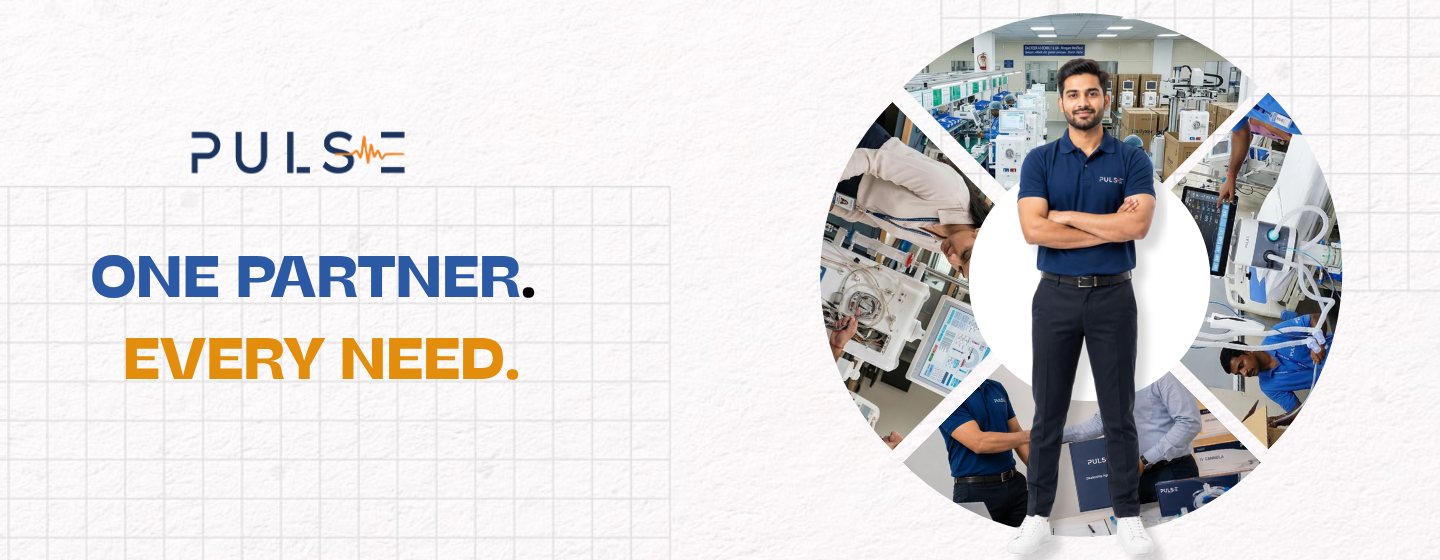
Pulse is built specifically to occupy that narrower list. As a horizontal MedTech OEM, Pulse designs, manufactures, and services its own equipment across critical care, renal care, cardiac care, aesthetics, rehabilitation, and hospital setup, as a single accountable entity rather than a distributor assembling other companies' products under one roof.
That structure is what makes the single-vendor benefits discussed above practically achievable for a hospital: one compliance file per product line instead of six, one service contract instead of six, and a 96-hour on-ground service response that doesn't depend on which category the failing equipment happens to fall into. Every product is certified against ISO 13485, CE, and CDSCO, including the post-2023 licensing requirements for Class C/D devices, so the compliance depth a hospital would expect from a specialist manufacturer isn't traded away for breadth.
This doesn't make Pulse a replacement for every specialist on the list above — a hospital doing high-volume transcatheter valve procedures will still want a cardiac implant specialist in the conversation. But for the departmental and general equipment that makes up the bulk of most hospitals' procurement volume, a single manufacturer covering that full range is the structural condition the pricing, standardization, and service-response benefits above actually depend on.
A Practical Checklist for Evaluating a Single-Vendor Partner
- Map your actual equipment categories against the vendor's real manufacturing portfolio — not just their marketing material
- Ask what percentage of their catalogue they manufacture in-house versus resell from other OEMs
- Request evidence of manufacturing redundancy (multiple facilities) to gauge supply disruption risk
- Get a written, contractual service response time — the single biggest factor in whether consolidation pays off day to day
- Confirm current-year CDSCO, ISO 13485, and CE documentation per product line
- Ask two comparable hospitals for references specific to multi-department equipment supply, not a single category
- Decide upfront whether you want full consolidation or a hybrid model — one primary partner plus specialist vendors for niche categories
The Bottom Line
The evidence for single-vendor medical equipment partnerships is real but conditional. The pricing, standardization, and service-response benefits are well documented. But they only materialize if the vendor a hospital consolidates around genuinely has the category breadth, manufacturing scale, and compliance depth to support it. Most of India's major device manufacturers are excellent within their specific vertical; few are built to be a true single point of accountability across a general hospital's full equipment list. The right evaluation is not "single vendor versus multiple vendors" as a philosophy. It is whether a specific candidate's actual manufacturing footprint matches what your hospital needs covered.