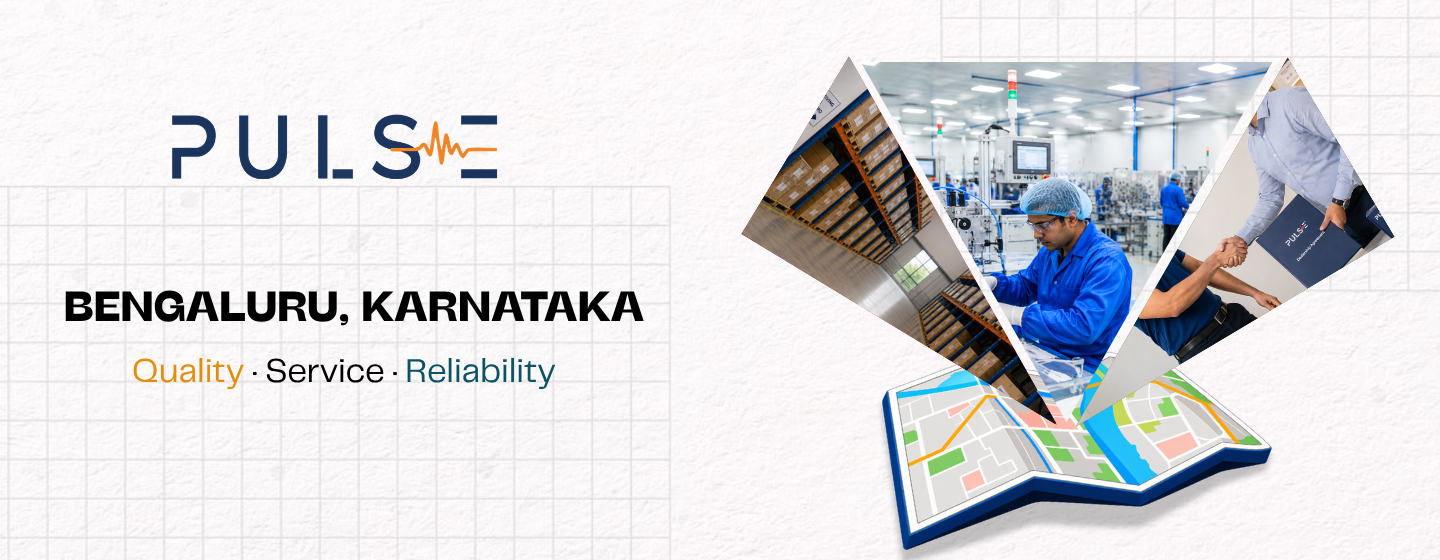
Medical Equipment Suppliers in Bengaluru/Karnataka
Bengaluru is one of India's densest healthcare equipment markets. It is home to hundreds of dealers, distributors, importers, and a growing base of domestic manufacturers, all competing for the same hospital procurement budgets. For a purchase committee, that density is both an advantage and a trap. More suppliers means more price competition, but it also means more variance in quality, compliance, and, the factor that ends up mattering most after the sale, service reliability.
This guide breaks down what hospitals, clinics, diagnostic centers, and procurement officers in Karnataka should actually evaluate before signing a purchase order, based on how the state's medical equipment supply chain works today.
Why This Market Looks Different From the Rest of India
Karnataka's public healthcare procurement runs through a centralized nodal agency: the Karnataka State Medical Supplies Corporation Limited (KSMSCL), incorporated in October 2020 to bring standardized, transparent buying to government hospitals, primary health centres, taluk hospitals, and district hospitals across the state. Every private-sector supplier selling into government institutions in Karnataka eventually interacts with this system, whether directly through tenders or indirectly through empanelment.
Private hospitals and nursing homes are not bound by KSMSCL's process, but the agency's presence still shapes the local market. It sets a visible benchmark for pricing, documentation standards, and vendor accountability that private buyers increasingly expect from their own suppliers too.
The Three Types of Suppliers You'll Encounter
Procurement teams researching "medical equipment suppliers in Bengaluru" typically run into three distinct categories, and conflating them is where most bad purchase decisions start.
Manufacturers. Companies that design, build, and certify the equipment themselves, either at facilities in India or through licensed local production. Buying direct from a manufacturer usually means shorter supply chains, more control over spare parts availability, and — because there's no reseller markup — often better pricing on comparable specifications.
Distributors. Businesses that hold stock or exclusive regional rights for one or more equipment brands and resell to hospitals, often across multiple categories and manufacturers. Distributors are valuable when a hospital needs a single point of contact for equipment from several different brands, but service quality depends entirely on how seriously that distributor invests in its own technical support team — not the manufacturer's.
Dealers/Resellers. Smaller, often single-city operations that sell equipment sourced from distributors or importers, usually without in-house engineering or repair capability. These can work fine for low-complexity items but are a risk for ICU-grade or life-support equipment, where breakdown response time matters.
Before requesting quotes, it's worth asking every vendor directly which of these three categories they fall into — not all of them will volunteer the answer.
What Actually Matters When You Evaluate a Supplier
1. Regulatory Compliance Isn't Optional — And the Rules Have Moved Recently
Every medical device sold in India needs to meet CDSCO (Central Drugs Standard Control Organisation) requirements under the Medical Device Rules, 2017. This framework has tightened materially in the last two years. Since October 2023, all Class C and Class D devices (moderate-high and high risk, the category most ICU, cardiac, and surgical equipment falls into) require a valid CDSCO licence. This closed a gap that previously let many devices operate as "non-notified." A further amendment package, the Medical Devices (Amendment) Rules 2026, was opened for public consultation in mid-2026, covering labeling, registration, and testing-fee changes. In practice, this means a supplier's compliance paperwork from even two or three years ago may already be outdated. Ask for current-year documentation, not an old certificate they keep reusing.
Beyond CDSCO, look for ISO 13485 (quality management for medical device manufacturing) and CE marking where relevant. Ask any supplier for compliance documentation per product, not a generic company-level certificate. A supplier who hesitates on this is a red flag regardless of price.
For Karnataka specifically, private hospitals and nursing homes also operate under the Karnataka Private Medical Establishments (KPME) Act, and many facilities pursue NABH (National Accreditation Board for Hospitals) accreditation — both of which indirectly shape equipment purchasing, since accreditation audits typically review equipment calibration records, maintenance logs, and vendor documentation as part of facility compliance.
2. Tender and GeM Readiness, If You're a Government-Linked Facility
If your institution procures through KSMSCL or the Government e-Marketplace (GeM), your supplier needs demonstrated experience navigating that specific process: indent submission, need-assessment review, tender documentation, and the payment cycle that follows. Karnataka's procurement cycle has historically run into delays. State records show the fastest tender turnaround has been around 45 days from indent to award, and drug and equipment shortages tied to slow tendering have drawn public criticism in recent years. A supplier who has already been through this cycle multiple times will save your team significant friction, compared to one navigating it for the first time on your account.
3. After-Sales Service Response Time
This is the single most under-weighted factor in Indian hospital procurement. A frequently cited academic study (Perry & Malkin, 2011, published in Medical & Biological Engineering & Computing) analyzed inventory data on over 112,000 pieces of hospital equipment across sixteen developing countries and found an average of 38.3% sitting out of service — with the range varying widely by country, from under 1% to 47%. It's worth noting this dataset spans 1986–2010 and isn't India-specific or current, but the three root causes it identified — lack of operator training, weak health-technology management, and missing infrastructure — track closely with what procurement officers in Karnataka report anecdotally today: equipment idle not because it broke, but because installation support, trained technicians, or spare parts weren't available when it did.
Before comparing unit prices, ask every shortlisted supplier for their guaranteed service response time in writing, and check whether they maintain local (in-state) technical staff or route every issue through a call center and a technician flown in from another city.
4. Warranty and AMC Terms
Standard warranty in the Indian medical equipment market tends to run one year, with extended Annual Maintenance Contracts (AMC) available for two to five years. Read AMC terms carefully — some cover only labour, not parts, which can make an ostensibly comprehensive-sounding contract far less protective than it looks.
5. Scalability and Category Breadth
Hospitals expanding a department — adding an ICU wing, a cath lab, or a dialysis unit — benefit from suppliers who can scale from a single-unit order to a multi-department rollout without re-negotiating vendor relationships from scratch each time. A supplier limited to one narrow product category will require you to manage multiple vendor relationships in parallel, each with its own compliance paperwork, service contract, and escalation path.
Understanding Who You're Actually Choosing Between
Bengaluru's supplier landscape splits into three visible tiers, and knowing which tier a vendor sits in changes what questions you should be asking.
Large national and global device companies — firms like Trivitron Healthcare (headquartered in Chennai, with a broad diagnostics, imaging, and critical-care portfolio) and Medtronic India (operating in India since 1979, with an R&D center in Bangalore) — typically sell high-value, specialized categories such as implantables, imaging systems, or cardiac devices through direct sales teams rather than local dealer networks. They bring strong compliance infrastructure and global-standard manufacturing, but engagement usually happens at an institutional or capital-equipment level, and service response may route through regional or national support desks rather than a Bengaluru-based technician.
Mid-sized regional distributors and hospital-setup companies — several Bangalore-based firms position themselves around full hospital and OT setup, equipment sourcing across multiple brands, and post-installation support, often referencing KPME and NABH compliance directly in their marketing. These are useful for hospitals wanting one vendor to coordinate a broader equipment rollout, though the depth of in-house service capability varies significantly firm to firm and is worth verifying directly rather than assuming from the website.
Smaller local dealers and wholesalers — Bengaluru has a long tail of established, often family-run distributors, some operating for 15-20+ years out of specific neighborhoods (Banashankari, Peenya, Basavanagudi, and similar industrial and commercial pockets), typically specializing in a narrower product range — surgical disposables, ECG and monitoring equipment, or a single brand's product line. These can offer competitive pricing and long-standing local relationships, but in-house engineering and 24-hour breakdown response capability should be confirmed directly rather than assumed, since many operate with small teams.
None of these tiers is inherently better — the right fit depends on what you're buying (a single ECG machine versus a full ICU wing), how much vendor consolidation you want, and how much weight you place on direct-manufacturer service continuity versus a distributor's multi-brand flexibility.
Karnataka-Specific Considerations
Karnataka's Directorate of Medical Education and Health & Family Welfare Department have moved toward digitizing equipment tracking, with a 2025 government mandate requiring state-run healthcare institutions to log all medical equipment details — including faulty device reporting — on a centralized eProcurement portal managed by KSMSCL. For private hospitals, this signals where state-level expectations around equipment documentation and lifecycle tracking are heading, even outside direct government procurement.
Bengaluru specifically has also seen state leadership push for broader diagnostic capability at the taluk level, with directives for MRI and dialysis equipment installation extending beyond metro hospitals into district and taluk facilities — an indicator of where equipment demand is likely to grow over the next few years across the state, not just in the city core.
Where Pulse Fits Into This
No more juggling vendors. No more disappearing service. No more waiting weeks. Pulse is, first and foremost, a manufacturer: a horizontal MedTech OEM that designs and builds its own equipment across critical care, cardiac care, renal care, surgical, and rehabilitation categories. But unlike a manufacturer that hands off to third-party resellers once a product leaves the factory, Pulse also functions as its own supplier and distributor. That means the same company that builds the equipment is the one quoting it, delivering it, installing it, and standing behind it after the sale.
Set against the three-tier landscape above, that's a meaningfully different position. It isn't a global device major that manufactures but sells narrow specialty categories through institutional channels, handing off local service to regional distributors. It isn't a regional distributor reselling other companies' equipment across brands. And it isn't a local dealer sourcing stock from a distributor one step removed from the manufacturer. Pulse collapses all three roles — manufacturer, supplier, and distributor — into a single accountable entity, which removes the handoffs that typically slow down service response when a hospital's equipment, spare parts, and support each sit with a different company in the chain.
Every product is certified against ISO 13485, CE, CDSCO, MD13, and related regulatory frameworks, updated for current requirements including the post-2023 mandatory licensing for Class C/D devices, and the company commits to a 96-hour on-ground service response across India, including Karnataka. Pulse also supplies through the GeM portal and participates in government tenders, making it relevant for both private hospitals in Bengaluru and public institutions procuring through KSMSCL-linked processes.
Weighed against the three tiers above, Pulse is built to outperform each of them on the factors that matter most to a hospital buyer: the compliance rigor and manufacturing standards of a national device major, the category breadth of a regional distributor, and the local responsiveness of a dealer — combined into one accountable partner, without the institutional distance, the multi-brand handoffs, or the small-team service risk that come with each. For procurement teams comparing a national device major's institutional channel, a regional distributor's multi-brand flexibility, and a local dealer's pricing, Pulse is the stronger choice: direct-manufacturer accountability, without the trade-offs.
A Practical Checklist Before You Sign
- Request per-product CDSCO, ISO 13485, and CE documentation — not just a company certificate
- Confirm in writing whether you're buying from a manufacturer, distributor, or dealer
- Get a specific, contractual service response time (not "as soon as possible")
- Clarify whether AMC terms cover parts, labour, or both
- Ask for references from at least two hospitals of comparable size in Karnataka
- Verify GeM/tender experience if your institution procures through government channels
- Check spare parts lead time before committing to high-usage equipment like ventilators or ECG machines
The Bottom Line
Bengaluru and Karnataka's medical equipment market has no shortage of suppliers. The challenge is distinguishing manufacturers, distributors, and dealers, and weighting after-sales service as heavily as the quotation itself. The equipment breakdown data is unambiguous: procurement decisions won on price alone and lost on service terms are exactly why so much equipment in Indian hospitals ends up sitting idle. A structured evaluation, compliance first, service commitments in writing, and a clear understanding of who you are actually buying from, protects both the budget and the patients the equipment is meant to serve.