How a Biochemistry Analyzer Works: Photometry, Assays and QC
A biochemistry analyzer turns a colour change into a number, such as your blood sugar. This guide explains how it reads light, the main test types, why heat and calibration matter, and what can go wrong with a sample.
A biochemistry analyzer mixes serum or plasma with a reagent that changes colour. It shines light of a set wavelength through the mixture and measures how much passes through. The change in light is proportional to the amount of the substance. End-point tests read at start and end; kinetic tests read the rate of change.
The Basic Idea: Colour and Light
Most lab chemistry tests use light. The sample (serum or plasma) is mixed with a liquid reagent. The reagent reacts with the substance being tested, such as glucose or cholesterol, and makes a colour. A photometer then shines light of one wavelength through the mixture and measures how much light passes through. With other conditions held steady, the change in light is proportional to the amount of the substance.
For what these tests cost patients, see our LFT and KFT test price and blood sugar test price guides.
Main Parts of the Analyzer
| Part | What it does |
|---|---|
| Light source | Gives steady light, for example a halogen lamp |
| Filters | Pick the wavelength each test needs, such as 340, 405 or 505 nm |
| Flow cell or cuvette | Holds the reaction mixture in the light path |
| Detector | Measures how much light comes through |
| Incubator | Keeps reactions at a set temperature, often 37°C |
| Software | Turns light readings into results, stores QC and prints reports |
Setting up a lab or clinic?Get a written quote, brochure or demo from the Pulse team.
End-Point vs Kinetic Tests
- End-point: the analyzer reads the light at the start and at the end of the reaction. The size of the change gives the concentration.
- Kinetic (rate): the analyzer reads the light several times and measures how fast it changes. The rate gives the activity, usually of an enzyme such as ALT or AST.
Heat, pH and the reagent all change how fast a reaction runs. So kinetic results and normal ranges can differ between machines. This is one reason each lab sets its own normal range.
Calibration and Quality Control
Calibration links the light reading to a known amount, using a standard. Liquid reagent systems need regular control runs and should be calibrated again from time to time. We suggest running controls at the start of each day or shift and after any reagent lot change, following the reagent maker's insert. See our lab quality control guide for how to read control charts.
Sample Problems That Affect Results
- Haemolysis (broken red cells): red cells hold more AST, ALT and LDH than plasma, so haemolysis can falsely raise them. It also changes the colour reaction.
- Lipaemia (milky, fatty sample): makes the sample cloudy and can falsely raise some results, such as bilirubin and creatinine, on liquid systems.
- Icterus (high bilirubin): can affect some bilirubin and creatinine methods.
Most systems use a blank reading to reduce these effects, but how well this works varies. We suggest asking for a fresh sample if the first is badly haemolysed.
What About Sodium and Potassium?
Salts such as sodium and potassium are usually measured with ion-selective electrodes (ISE), not colour. An ISE gives a voltage that depends on how much of the salt is present. Small voltage errors can make a big difference, so the electrodes need regular care.
Semi-Automatic or Fully Automatic?
In a semi-automatic analyzer, the technician pipettes the sample and reagent and the analyzer reads the result. In a fully automatic analyzer, the machine does every step. See our biochemistry analyzer price guide.
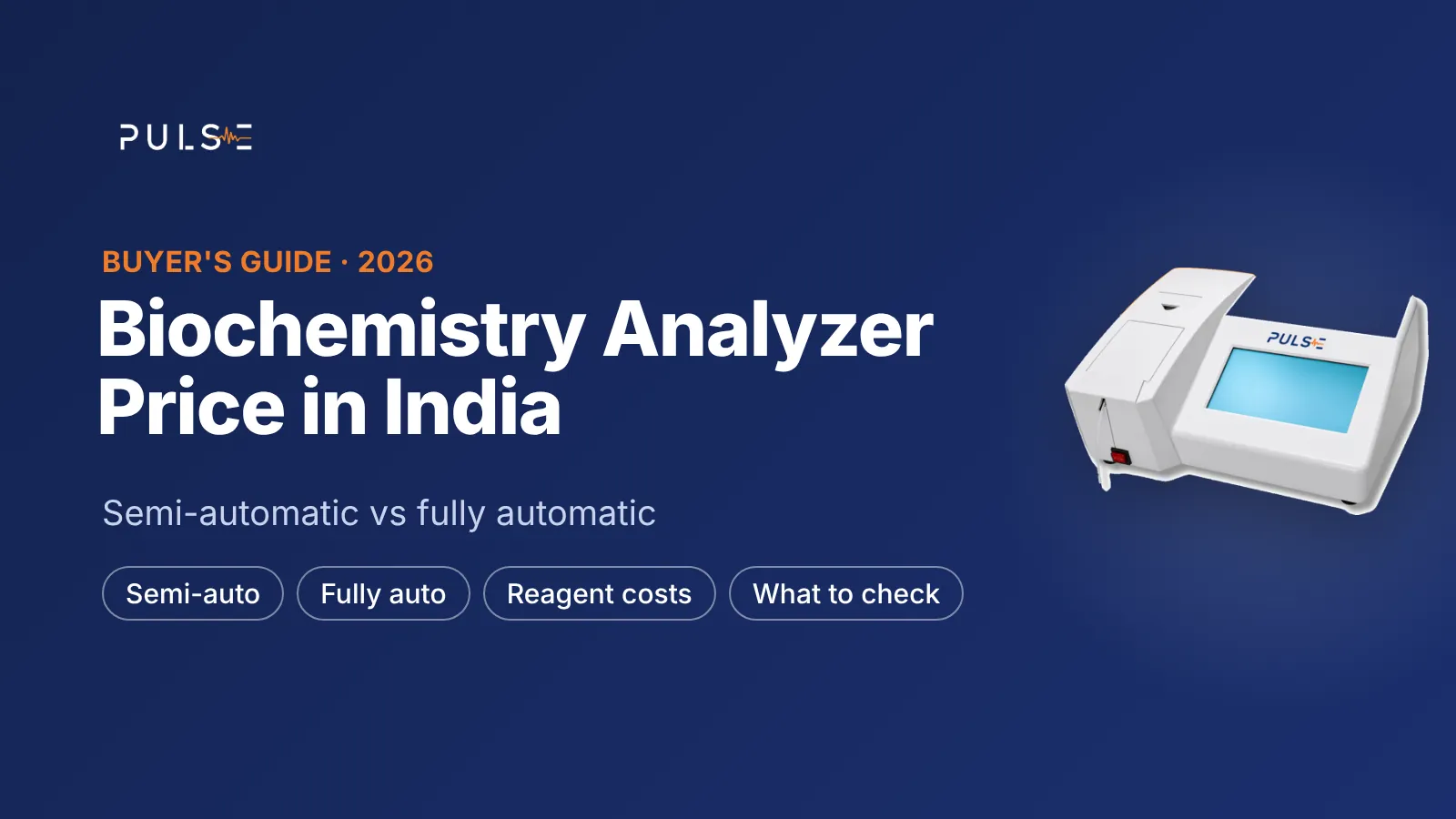
Pulse ZT Smart SAA
The Pulse ZT Smart SAA is a clinical chemistry analyzer with:
- An automatic 8-position filter wheel: 340, 405, 505, 546, 578 and 630 nm, with 2 free positions.
- A tungsten halogen lamp and a 32 µL quartz-window flow cell.
- 10 incubator positions with Peltier control at 25, 30 or 37°C.
- End-point, fixed-time, rate, two-point, non-linear, multi-standard and coagulation assay types.
- Storage for 120 programs and 25,000 results with reaction curves and QC data.
How a Biochemistry Analyzer Works: Key Facts
- Biochemistry analyzers measure how much light a coloured reaction mixture lets through.
- End-point tests read at the start and end; kinetic tests read the rate of change.
- Temperature and reagents affect kinetic results, so ranges differ between labs.
- Haemolysis, lipaemia and icterus can give falsely high or low results.
- Sodium and potassium are usually measured with ion-selective electrodes.
How a Biochemistry Analyzer Works: FAQs
What is the principle of a biochemistry analyzer?
Photometry. The sample reacts with a reagent to form a colour, and the analyzer measures how much light of a set wavelength passes through. The change is proportional to the amount of the substance.
What is the difference between end-point and kinetic assays?
An end-point assay reads the light at the start and end of the reaction. A kinetic assay reads how fast the light changes, and is used mainly for enzymes.
Why do biochemistry results differ between labs?
Reagents, temperature and methods differ, especially for enzyme tests, so each lab sets its own reference range.
How does haemolysis affect biochemistry results?
Red cells hold more AST, ALT and LDH than plasma, so a haemolysed sample can show falsely high values. It also changes the colour reaction.
How are sodium and potassium measured?
Usually with ion-selective electrodes, which give a voltage that depends on the ion concentration.
Does Pulse supply biochemistry analyzers?
Yes. The Pulse ZT Smart SAA has an 8-position filter wheel, Peltier incubation and storage for 25,000 results. Message +91 90711 01108 for a quote.
Sources
- The basics of biochemistry instrumentation (laboratory medicine conference proceedings, dvm360, April 2010, updated April 2020): photometry, end-point and rate assays, calibration, ISE, sample interferences
- Pulse ZT Smart SAA product page: wavelengths, lamp, flow cell, incubator, assay types, storage
Related Reading