Biochemistry Analyzer Price in India: Semi-Auto vs Fully Auto
A biochemistry analyzer is the second machine most labs buy after a hematology analyzer. This guide explains the price bands, the difference between semi-automatic and fully automatic analyzers, and the reagent costs that decide your cost per test.
How much does a biochemistry analyzer cost in India? Bajaj Finserv's August 2026 guide puts semi-automatic analyzers at Rs 40,000 to Rs 1.25 lakh, portable analyzers at Rs 60,000 to Rs 1.5 lakh, benchtop analyzers at Rs 2 lakh to Rs 5 lakh, fully automatic analyzers at Rs 2.2 lakh to Rs 6 lakh and floor-standing analyzers at Rs 4 lakh to Rs 10 lakh.
Biochemistry Analyzer Price Ranges in India
| Type | Typical price range | Best suited to |
|---|---|---|
| Semi-automatic analyzer | Rs 40,000 to Rs 1.25 lakh | Clinics and small labs with a few dozen tests a day |
| Portable analyzer | Rs 60,000 to Rs 1.5 lakh | Point-of-care testing, camps, small centres |
| Benchtop analyzer | Rs 2 lakh to Rs 5 lakh | Growing labs and nursing homes |
| Fully automatic analyzer | Rs 2.2 lakh to Rs 6 lakh | Busy labs that want walk-away testing |
| Floor-standing analyzer | Rs 4 lakh to Rs 10 lakh | Hospital and reference labs with high volumes |
What a Biochemistry Analyzer Does
A biochemistry (clinical chemistry) analyzer measures chemicals in blood, serum and urine. It mixes the sample with a reagent and reads the colour change with light at a set wavelength. The result gives values for tests such as blood sugar, liver function (LFT), kidney function (KFT), lipid profile, uric acid and electrolytes.
Need a price for your hospital or clinic?Get a written quote, brochure or demo from the Pulse team.
Semi-Automatic or Fully Automatic?
In a semi-automatic analyzer, a technician pipettes the sample and reagent by hand and the machine incubates and reads the result. It costs less and suits clinics and small labs. In a fully automatic analyzer, the machine pipettes, mixes, incubates and reads by itself, so staff can load samples and walk away. It handles many more tests an hour with fewer manual errors.
| Point | Semi-automatic | Fully automatic |
|---|---|---|
| Pipetting | By hand | By the machine |
| Speed | Lower, one test at a time | Higher, many tests together |
| Staff time | A technician stays with the machine | Walk-away after loading |
| Price | Lower | Higher |
| Best for | Low daily volume | Medium to high daily volume |
What Drives the Price
1. Level of automation and speed
Fully automatic analyzers with more tests per hour cost more, but save staff time on busy days.
2. Open or closed reagents
An open system accepts reagents from many brands, so you can buy on price and availability. A closed system works only with the maker's reagents.
3. Wavelengths, incubation and storage
More filter wavelengths and temperature options cover more tests. Larger result memory and quality control (QC) tools help with accreditation.
4. Connectivity
A link to your lab software or printer saves typing and reduces mistakes.
5. Running costs
Reagents, calibrators, controls, cuvettes and the lamp are ongoing costs. Over a few years, cost per test usually matters more than the machine price.
Pulse Models at a Glance
| Model | Key details |
|---|---|
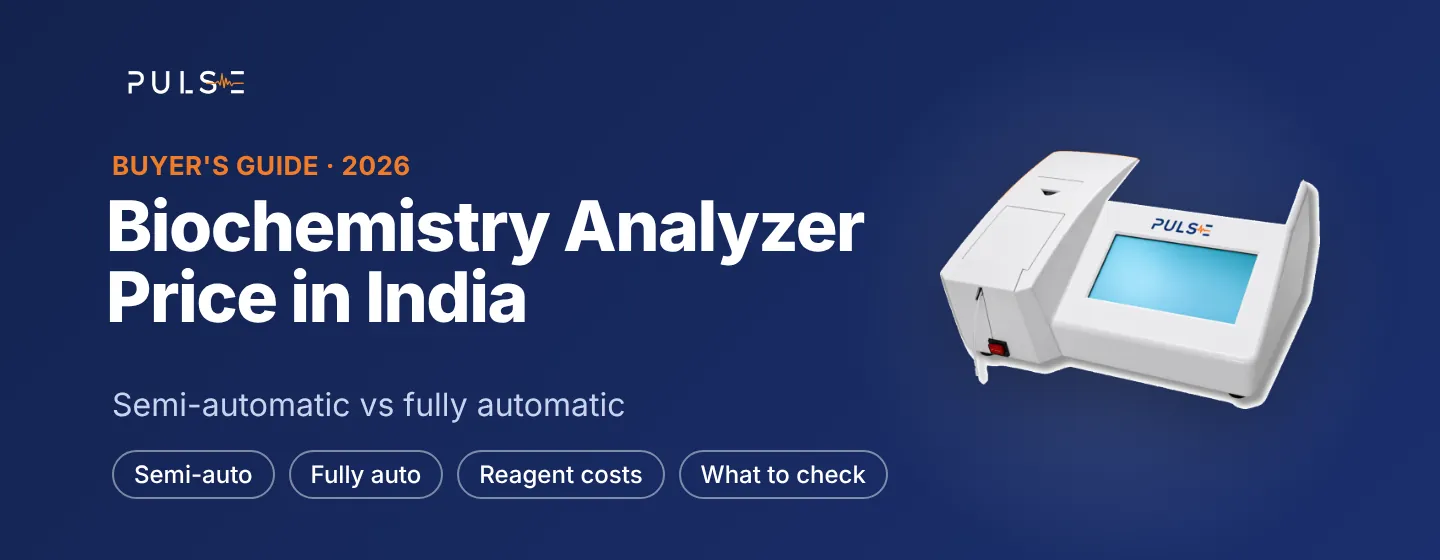
| ZT Smart SAA Biochemistry Analyzer | Compact clinical chemistry analyzer; 7-inch touchscreen; 25,000 test records with reaction curves and QC; 10 incubator positions at 25, 30 and 37°C; open to all biochemistry reagents; optional built-in printer |
Biochemistry Analyzer Price in India: Key Facts
- Semi-automatic biochemistry analyzers cost about Rs 40,000 to Rs 1.25 lakh in India (Bajaj Finserv, August 2026).
- Fully automatic analyzers cost about Rs 2.2 lakh to Rs 6 lakh.
- Floor-standing analyzers cost about Rs 4 lakh to Rs 10 lakh.
- Open reagent systems let labs choose reagents on price and availability.
- The Pulse ZT Smart SAA is open to all biochemistry reagents.
Biochemistry Analyzer Price in India: FAQs
How much does a biochemistry analyzer cost in India?
Bajaj Finserv's August 2026 guide puts semi-automatic analyzers at about Rs 40,000 to Rs 1.25 lakh, fully automatic analyzers at Rs 2.2 lakh to Rs 6 lakh and floor-standing analyzers at Rs 4 lakh to Rs 10 lakh.
What is the difference between semi-automatic and fully automatic biochemistry analyzers?
In a semi-automatic analyzer the technician pipettes sample and reagent by hand. A fully automatic analyzer pipettes, mixes, incubates and reads by itself, so it handles more tests with less staff time.
Which tests does a biochemistry analyzer run?
Common tests include blood sugar, liver function, kidney function, lipid profile, uric acid and other clinical chemistry tests, depending on the reagents used.
What is an open reagent system?
An open system accepts reagents from many brands, so the lab can buy reagents on price and availability. A closed system works only with the maker's reagents.
What should a lab check before buying?
Check daily test volume, cost per test, open or closed reagents, wavelengths, QC tools, connectivity, warranty and local service.
How do I get a price for the Pulse ZT Smart SAA?
Message Pulse on WhatsApp at +91 90711 01108 with your lab location and daily test volume, and the team will share a quote.
Sources
- Biochemistry Analyzer Machine Price by Type (Bajaj Finserv, August 2026): price ranges by type
- Pulse ZT Smart SAA product page: analyzer details
Related Reading