ECG Normal Values: PR Interval, QRS Duration and QT Explained
Every ECG report lists a few key timings: the PR interval, the QRS duration and the QT (or QTc). This guide explains what each one measures, the normal adult values, how to read them from the paper, and what long or short values can mean.
Normal adult ECG intervals: PR 120 to 200 ms (3 to 5 small boxes), QRS under 100 ms, and QTc up to about 440 ms in men and 460 ms in women. A QTc over 500 ms raises the risk of a dangerous heart rhythm.
Reading the ECG Paper
At the standard paper speed, each small box is 0.04 seconds (40 ms) and each big box, made of 5 small boxes, is 0.2 seconds (200 ms). Intervals are measured from left to right. ECG machines with automatic measurement also print these values on the report.
Normal Adult ECG Intervals
| Interval | What it measures | Normal (adults) |
|---|---|---|
| PR interval | Time for the signal to travel from the upper to the lower heart chambers | 120 to 200 ms (3 to 5 small boxes) |
| QRS duration | Time for the lower chambers (ventricles) to be activated | Under 100 ms |
| QT interval | Time for the ventricles to activate and recover | Depends on heart rate; use QTc |
| QTc (corrected QT) | QT adjusted to a heart rate of 60 | Up to about 440 ms (men) and 460 ms (women) |
For heart rate and other monitor readings, see our patient monitor normal values guide.
Buying an ECG machine?Get a written quote, brochure or demo from the Pulse team.
PR Interval: Long or Short
- Over 200 ms: first-degree AV block, a delay in the signal passing through the heart's AV node.
- Under 120 ms: can mean an extra electrical pathway (such as Wolff-Parkinson-White syndrome) or a rhythm starting near the AV node.
QRS: When Is It Wide?
- 100 to 119 ms: a mild delay in conduction inside the ventricles.
- 120 ms or more: suggests a bundle branch block.
QT and QTc
The QT runs from the start of the QRS to the end of the T wave. It gets shorter as the heart beats faster, so doctors use the corrected value, QTc. The most common formula, Bazett's, divides the QT by the square root of the time between beats (RR, in seconds). It over-corrects at fast heart rates and under-corrects at slow ones, so other formulas such as Fridericia are used outside 60 to 100 beats per minute.
- QTc over 500 ms: linked to a higher risk of a dangerous rhythm called torsades de pointes.
- QTc under 350 ms: abnormally short.
- Common causes of a long QTc: low potassium, magnesium or calcium, some medicines, heart muscle ischaemia, very low body temperature and inherited long QT syndrome.
A quick rule of thumb: a normal QT is usually less than half the time between two heartbeats.
Tips for Accurate Readings
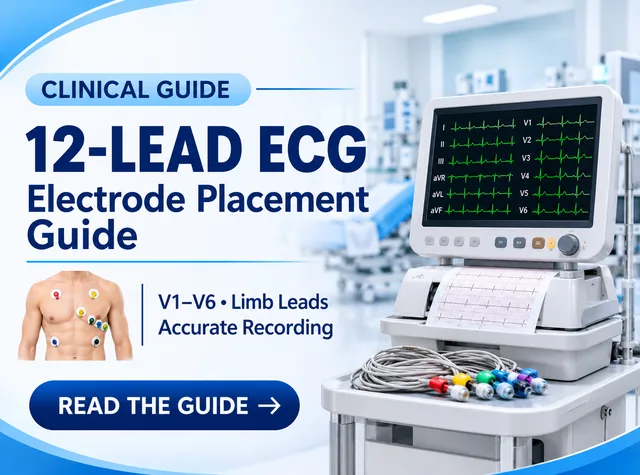
Wrong electrode positions and patient movement can change the tracing. See our 12-lead ECG electrode placement guide. For what patients pay, see our ECG test price guide.
Pulse ECG Machines
- 3-channel ECG: 12-lead recording with automatic interpretation, 7 inch touchscreen and lithium-ion battery.
- 6-channel ECG: automatic interpretation and defibrillator protection.
- 12-channel ECG: automatic measurements and interpretation, 1,000-case storage and data transfer to a PC.
Pulse critical care devices are CDSCO cleared and CE marked, made under ISO 13485. Automatic measurements should always be checked by a trained reader.
ECG Normal Values: Key Facts
- A normal adult PR interval is 120 to 200 ms, or 3 to 5 small boxes.
- A QRS of 120 ms or more suggests bundle branch block.
- QTc is prolonged above about 440 ms in men and 460 ms in women.
- A QTc over 500 ms raises the risk of torsades de pointes.
- Each small box on ECG paper is 40 ms and each big box is 200 ms.
ECG Normal Values: FAQs
What is a normal PR interval?
120 to 200 ms in adults, which is 3 to 5 small boxes on standard ECG paper.
What is a normal QRS duration?
Under 100 ms. A QRS of 120 ms or more suggests a bundle branch block.
What is a normal QTc?
Up to about 440 ms in men and 460 ms in women. A QTc over 500 ms raises the risk of a dangerous rhythm.
What does a PR interval over 200 ms mean?
First-degree AV block, a delay in the signal passing through the AV node.
What causes a long QT?
Low potassium, magnesium or calcium, some medicines, ischaemia, very low body temperature and inherited long QT syndrome.
Do Pulse ECG machines measure intervals automatically?
Yes. Pulse 3, 6 and 12-channel ECG machines offer automatic interpretation. Message +91 90711 01108 for a quote.
Sources
- The PR, QRS and QT intervals (Washington State University medical school ECG course, undated): box timings, normal PR, QRS and QTc, wide QRS
- PR interval (Life in the Fast Lane ECG Library, undated): normal PR and causes of long and short PR
- QT interval (Life in the Fast Lane ECG Library, undated): QTc limits for men and women, 500 ms risk, causes, formulas
Related Reading