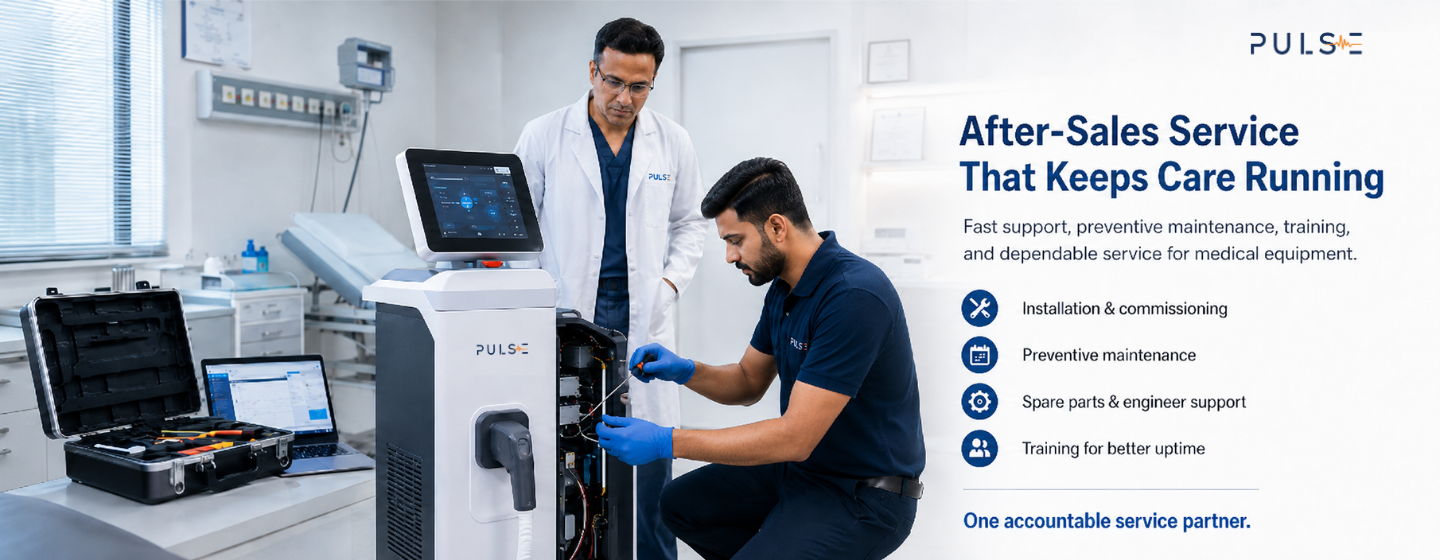
Why After-Sales Service Matters in Medical Equipment Purchasing
Here is the most uncomfortable statistic in global healthcare technology: in a landmark study of 112,040 pieces of medical equipment across sixteen countries, an average of 38.3% sat out of service in developing-world hospitals. In high-income countries, the same figure is under 1%.[1] The machines were not the problem. What was missing was everything that happens after the sale — installation, training, spare parts, preventive maintenance, and an engineer who actually shows up. This is the case for why after-sales service should weigh as heavily as price in every medical equipment purchase decision.
Most equipment purchase decisions in India are still won and lost on the quotation. Procurement committees compare unit prices to the rupee, negotiate hard on the invoice — and then treat the service terms as fine print. The data says this is exactly backwards. Over a machine's 7-10 year life, the purchase price is typically only 30-40% of what you will spend; service, parts, consumables, and downtime make up the rest.[2] A cheaper machine with weak service support is very often the most expensive thing a hospital ever buys.
The Graveyard Problem: Where Equipment Goes to Die
Walk into the back corridor of almost any district hospital and you will find it: the equipment graveyard. A patient monitor with a dead display. A suction machine missing one tube. An anesthesia workstation that needed a ₹4,000 sensor nobody could source. None of these machines "wore out" — they failed at a single, fixable point and stayed failed because no service pathway existed.
The research on why equipment dies is unambiguous. The 2011 study of 112,040 devices identified the three main causes of out-of-service equipment as lack of training, absent health technology management, and infrastructure gaps — not manufacturing defects.[1] The WHO has separately estimated that 50-80% of medical equipment in developing countries is non-functional at any given time,[3] and that only 10-30% of donated equipment ever becomes operational.[4]
India has its own official numbers. When the National Health Mission mapped public-sector equipment for its Biomedical Equipment Management & Maintenance Program (BEMMP), it inventoried 7,56,750 pieces of equipment across 29,115 health facilities, worth approximately ₹4,564 crore — and found 13% to 34% of it dysfunctional, depending on the state.[5] NHM guidelines note that available evidence puts non-functional equipment at 30-60% in some states.[6] That is thousands of crores of public money sitting idle for want of service.
Medical Equipment Out of Service, by Setting
What Downtime Actually Costs (In Numbers Nobody Budgets For)
When a machine stops, the repair invoice is the smallest part of the bill. The real damage is the revenue and clinical capacity that vanish while it sits idle.
The published benchmarks are sobering. A single MRI scanner offline costs a facility roughly $10,000-15,000 (₹8-12 lakh) per day in lost revenue.[7] Imaging equipment downtime in general runs $3,000-8,000 per hour.[8] A typical unplanned failure lasts 6-8 hours per incident[9] — and a mid-sized hospital can lose close to $300,000 (₹2.5 crore) per year from imaging outages alone.[10] For an Indian cath lab, one four-hour outage can mean 3-4 cancelled procedures — ₹4-8 lakh of revenue gone before lunch, plus patients who may quietly book their angioplasty elsewhere.
And downtime is only half the story. Emergency repairs are structurally more expensive than planned service: reactive maintenance costs 3-5 times more than preventive maintenance for the same equipment,[11] and emergency parts procurement carries a 60-80% price premium over scheduled orders.[9]
Reactive vs. Preventive: The Cost Multiplier
Flip the numbers around and the case builds itself: structured preventive maintenance reduces unplanned downtime by 40-50%, cuts maintenance costs by 25-35% within the first year,[11] and extends equipment lifespan by 20-40%.[12] On a ₹5 crore MRI, a 30% lifespan extension is worth well over a crore in deferred capital expenditure. Every rupee spent on preventive service returns an estimated ₹3-5 in avoided emergency costs.[11]
The Regulator Already Agrees: Uptime Is Now a Requirement
In India, equipment service has quietly moved from "good practice" to formal obligation.
- NABH accreditation requires documented preventive maintenance schedules, equipment history sheets, and current calibration certificates for every clinical device. Missing calibration records are the single most common major non-conformance in NABH hospital surveys.[13]
- The Government of India's BEMMP ties maintenance contractor payments directly to uptime, with mandated targets of 95% uptime for District Hospitals, 90% for CHCs, and 80% for PHCs.[5] If the public sector holds its vendors to uptime SLAs, private buyers should expect no less.
- Insurance and TPA empanelment increasingly reviews equipment maintenance documentation as part of quality assessment — service records now affect revenue, not just operations.
What Good After-Sales Service Actually Looks Like
"Good service" is not a feeling — it is a set of measurable commitments. When evaluating any equipment vendor, these are the seven components that separate a service partner from a courier company with an invoice book:
- Installation and commissioning done properly. Formal installation qualification (IQ), operational qualification (OQ), and a signed user-acceptance protocol — not a delivery van and a handshake.
- User training, repeated. The number one cause of "broken" equipment in the developing world is untrained operators.[1] Good vendors train at installation and re-train as staff rotate.
- A written response-time SLA. In the Indian market, engineer dispatch within 24-48 hours is the working standard for service contracts,[14] with premium OEM contracts offering guaranteed response from as little as 2 hours and remote resolution for a large share of faults.[15]
- An uptime guarantee with teeth. 95% uptime commitments are now standard in the Indian AMC market[14] — but only meaningful when paired with penalties or service credits for shortfall.
- Spare parts availability, stated in writing. Ask where the nearest parts depot is and what the guaranteed dispatch time is. A machine waiting six weeks for an imported board is a machine that is effectively dead.
- Preventive maintenance on a published calendar — with documentation formatted to survive an NABH audit.
- A real escalation path. A named service manager and a working toll-free line, not a WhatsApp number that goes quiet after the cheque clears.
AMC vs. CMC: The Economics, Honestly
After the warranty ends, Indian buyers choose between two contract structures:
| Contract | Typical annual cost | Covers | Best for |
|---|---|---|---|
| AMC (Annual Maintenance Contract) | 3–4% of machine cost[16] | Preventive visits, inspection, labour; parts usually excluded | Newer, low-risk equipment; tight budgets |
| CMC (Comprehensive Maintenance Contract) | 7–10% of machine cost[16] | Everything in AMC plus parts, major repairs, breakdown support | Critical and high-use equipment; older machines |
The arithmetic worth doing before you choose: a single X-ray tube replacement on a premium CT scanner can exceed $200,000 (₹1.6+ crore)[9] — several years of CMC premiums in one invoice. For high-value, high-utilisation, breakdown-sensitive machines (CT, MRI, cath lab, dialysis, ventilators), the CMC premium is usually cheap insurance. For a manual examination couch, it is not. Overall, hospitals spend roughly 5-10% of operating budgets on equipment maintenance[17] — the goal of good vendor selection is not to eliminate that cost but to convert it from unpredictable emergencies into a planned line item.
Five Service Questions to Ask Before You Sign Any Purchase Order
Put these in writing to every vendor, and put the answers in the contract:
- What is your guaranteed engineer response time for my city — in hours, on paper?
- What uptime percentage do you commit to, and what happens if you miss it?
- Where are your spare parts stocked, and what is the guaranteed dispatch time for critical parts?
- What does the warranty actually cover — and what will AMC/CMC cost in years 2 through 7, in writing, today?
- How many trained service engineers do you have in my region — and can I speak to two existing customers they support?
A vendor who answers all five crisply is telling you they have a service operation. A vendor who gets vague on question three is telling you where your machine will be in eighteen months: in the corridor, with a tag on it.
Where Pulse Fits
Service is the reason Pulse exists in the shape it does. Vendor fragmentation is the silent killer of hospital service quality — one supplier for beds, another for OT lights, another for monitors, another for dialysis — each with its own contract, its own engineer network, its own definition of "we'll get back to you." When something breaks, the first hour is spent working out whose problem it is.
No more juggling vendors. No more disappearing service. No more waiting weeks. Pulse is a horizontal MedTech OEM brand — bringing quality, service, speed, and value into one accountable partnership.
Across seven verticals — Critical Care, Renal Care, Cardiac Care, Aesthetics, Rehabilitation, Hospital Setup, and Surgical — that means one service relationship, one escalation path, one partner whose name is on everything from the ICU bed to the ventilator on top of it. When the equipment list comes from one accountable OEM, after-sales service stops being a negotiation between vendors and becomes a single commitment.
See how Pulse service & support works →
Sources & Citations
- Perry L, Malkin R. "Effectiveness of medical equipment donations to improve health systems: how much medical equipment is broken in the developing world?" Medical & Biological Engineering & Computing (2011). Study of 112,040 devices across 16 countries, 1986-2010: average 38.3% out of service; top causes were lack of training, health technology management, and infrastructure. High-income comparison <1% per Marks et al.
- Total cost of ownership composition: healthcare procurement consultancy benchmarks; see also Pulse's Complete Guide to Buying Medical Equipment in India, Part 3.
- WHO estimate of 50-80% non-functional equipment in developing countries, as cited in Moyimane et al., "Experiences of nurses on the critical shortage of medical equipment at a rural district hospital in South Africa" (2017).
- WHO Guidelines for Health Care Equipment Donations: 10-30% of donated equipment becomes operational in developing countries; ~80% of equipment in low-income countries is donated.
- National Health Mission / NHSRC, Biomedical Equipment Management & Maintenance Program (BEMMP): 7,56,750 equipment items mapped across 29,115 facilities (~₹4,564 crore); 13-34% dysfunctional across states; uptime targets 95% (DH) / 90% (CHC) / 80% (PHC). See nhsrcindia.org.
- NHM Biomedical Equipment Revised Guidelines: "Available evidence indicates that 30%-60% of medical equipment is non-functional in different states."
- MRI downtime revenue loss $10,000-15,000/day: multiple industry analyses including Okon Recycling MRI lifecycle analysis and OxMaint hospital downtime economics reports (2025-2026). INR conversions approximate at ₹83/USD.
- Imaging equipment downtime $3,000-8,000/hour: OxMaint medical equipment maintenance industry data (2025).
- Downtime incident duration 6-8 hours; emergency parts premium 60-80%; CT X-ray tube replacement >$200,000: OxMaint hospital equipment downtime cost analyses (2026).
- ~$300,000 annual imaging-outage loss for a medium (200-bed) facility: Henson K., "The true cost of downtime in radiology," AuntMinnie, citing Basu & Jackson and Becker's Hospital CFO Report data.
- Reactive maintenance 3-5x cost of preventive; predictive/preventive programs reduce downtime 40-50% and maintenance costs 25-35%; ₹1 preventive returns ₹3-5: healthcare CMMS industry benchmarks (OxMaint, Nirmitee healthcare PM guides, 2025-2026).
- Preventive maintenance extends equipment lifespan 20-40%: predictive maintenance industry data; some India-focused guides cite up to 39% / 2-5 years of added service life.
- NABH facility management & equipment maintenance standards: documented PM schedules, history sheets, calibration certificates required; missing calibration records are the most common major non-conformance. Benchmark KPIs (95%+ critical uptime, MTTR <4 hrs, 80/20 PM ratio) per healthcare PM implementation guides aligned to NABH 6th Edition.
- Indian AMC market norms: 95% uptime guarantees and 24-48 hour engineer dispatch cited by national multi-brand service providers (e.g., Avoor Meddplus service disclosures, 2026).
- OEM premium service tiers: Siemens Healthineers service contracts offer guaranteed response from 2 hours; nearly half of repairs resolved remotely; remote monitoring reduced unplanned downtime by up to 70% in some facilities (Siemens Healthineers downtime calculator/service pages).
- AMC 3-4% and CMC 7-10% of machine cost: Medical Buyer, "How to procure high-end medical equipment" (2023); NiceHMS healthcare procurement guidance.
- Hospitals spend 5-10% of operating budgets on equipment maintenance: healthcare AMC/CMMS industry estimates (2025).