Complete Guide to Buying Medical Equipment in India
India's medical equipment market is on track to grow from around $17 billion in 2025 to $50 billion by 2030[1] — but for the person actually buying a ventilator, MRI, or hospital bed, the market's growth is not the story. The story is that a single equipment decision can involve seven regulatory approvals, a 3-to-6-month import timeline, ₹5 lakh to ₹5 crore in capital, and a service contract that will outlast the person who signed it. This guide walks buyers — hospitals, clinics, dealers — through what actually goes into buying medical equipment in India in 2026.
The Indian medical device sector today is genuinely different from what it was five years ago. Import dependency is still around 70-80%[2], but 22 greenfield manufacturing projects under the PLI scheme have gone live, over 55 device categories are now made domestically for the first time[3], and buyers have real choices between imported and Made-in-India equipment that didn't exist before. GST rationalization in September 2025 cut rates on most devices from 12% to 5%[4]. Financing options have expanded from just SBI and a few banks to a dozen NBFCs with collateral-free options up to ₹5 crore.[5]
The problem is that all these changes have made buying more complex, not less. Here's how to think about it, tier by tier.
The Three Buyer Segments — And Why the Advice Differs
Before we go into the regulatory, financial, and procurement details, understand which segment you're in. The framework applies to all buyers; the choices don't.
Segment 1 — Doctors / Small Clinics / Nursing Homes (10-30 beds)
Typical annual equipment spend: ₹5 lakh to ₹1 crore. Buying decisions are made by 1-2 people (usually the doctor-owner). Financing typically via professional loans, machinery loans, or NBFC quick-approval routes. Regulatory concern is limited to end-buyer compliance (AERB for X-ray, PCPNDT for ultrasound). Import licensing is a supplier's problem, not yours.
Segment 2 — Hospitals / Procurement Heads (30-500+ beds)
Typical equipment spend: ₹1-50 crore per year. Buying involves a formal procurement committee, tender processes, and multi-year service contracts. This segment lives or dies by total-cost-of-ownership discipline: the sticker price is often less than 40% of the 10-year cost. NABH accreditation shapes which equipment qualifies for hospital approval.
Segment 3 — Distributors / Dealers / Importers
Typical scale: Multi-crore inventory across 50-500 SKUs. Full regulatory burden: CDSCO import license (MD-14/MD-15), MD-42 wholesale registration, GST compliance, warranty logistics, service network build-out. Success in this segment is about regulatory speed and supply reliability, not procurement discipline.
Now the actual guide, structured by decision layer: regulatory first (because it's non-negotiable), financial second (because it determines what you can do), procurement third (because that's where you either win or lose).
Part 1: The Regulatory Layer — What Must Be Approved First
India's medical device regulation is governed by the Medical Devices Rules, 2017 (MDR 2017), administered by the Central Drugs Standard Control Organization (CDSCO) under the Ministry of Health and Family Welfare. Since 1 October 2022, every medical device sold in India — imported or locally made — must be licensed or registered.[6] There is no "unregulated" category anymore for anything the government has notified.
Device Classification: Everything Starts Here
MDR 2017 uses a risk-based four-class system inspired by the EU MDR framework:
- Class A (low risk) — Bandages, tongue depressors, wheelchairs, hospital beds, non-sterile examination gloves. Class A non-sterile, non-measuring devices don't require an import license.
- Class B (low-moderate risk) — Suction equipment, hypodermic needles, digital thermometers, most stethoscopes and BP monitors.
- Class C (moderate-high risk) — Ventilators, dialysis machines, infusion pumps, X-ray systems, ultrasound scanners, most imaging equipment.
- Class D (high risk) — Implantable devices (pacemakers, stents, orthopedic implants), heart-lung machines, cardiac catheters.
Classification determines everything downstream: which authority licenses it, what fees you pay, how long the approval takes, and what post-market obligations follow. Misclassification is the single most common reason applications are rejected — CDSCO does not follow up on incomplete or misclassified files.
For Buyers Sourcing Domestic Equipment
If you're buying from an Indian manufacturer, they carry the licensing burden — but you should verify they hold it. Ask for their Form MD-9 (manufacturing license) for Class C/D devices, or MD-5 for Class A/B. If they can't produce it, walk away. A missing license means the device you're buying is effectively contraband, and Central Establishment inspectors have shut down hospitals for stocking unlicensed devices.
For Buyers Sourcing Imported Equipment
Your supplier (or you, if you're the importer) needs an Import License in Form MD-15, granted by CDSCO after they submit Form MD-14 on the SUGAM portal. The fees, in USD:
| Class | Site Fee | Per-Device Fee |
|---|---|---|
| Class A (non-sterile/non-measuring) | Nil | Nil |
| Class A (sterile/measuring) | $1,000 | $50 |
| Class B | $2,000 | $1,000 |
| Class C | $3,000 | $1,500 |
| Class D | $3,000 | $1,500 |
Fees are payable through the SUGAM portal. In INR terms, Class A/B applications land around ₹83,000 per site; Class C/D around ₹2,49,900 per site plus additional device fees. Timelines run 3-6 months for a well-prepared application[8]; poor documentation adds 3-6 months regardless of class. The license itself is valid indefinitely but requires retention fees every 5 years.[9]
Post-Purchase Buyer Compliances (Often Missed)
Even if your supplier handles licensing, you still carry post-purchase responsibilities depending on equipment type:
- AERB license — mandatory for anything emitting radiation: X-ray, CT, mammography, fluoroscopy, cath labs, radiotherapy. Application via AERB e-LORA portal, ~30-60 days.
- PCPNDT registration — mandatory for ultrasound, MRI, or any device that can determine fetal sex. Under the PCPNDT Act, 1994, non-registration attracts serious penalties.
- BMW authorization — biomedical waste management authorization under BMW Rules 2016 for any equipment generating clinical waste.
- Blood bank/storage license — for any blood-storage-capable equipment.
- Legal Metrology certification — for measuring devices with a metrological function.
These aren't equipment supplier obligations. They're yours as the operating facility.
GST on Medical Equipment (Post-September 2025 Rationalisation)
The 22 September 2025 GST 2.0 reform simplified rates significantly. Current structure:
| Equipment Category | GST Rate |
|---|---|
| Most medical instruments (HSN 9018): syringes, ECG, ultrasound, X-ray, ventilators, dialysis, patient monitors | 5% |
| Diagnostic kits, IVDs | 5% |
| Life-saving drugs (37 specified categories) | Nil |
| Medical furniture (HSN 9402): hospital beds, OT tables, examination couches, dental chairs | 18% |
| Laboratory glassware, dental hygiene products, some accessories | 18% |
The rate cut on core equipment from 12% (pre-Sept 2025) to 5% is a real savings — on a ₹1 crore ventilator order, that's ₹7 lakh less in GST outgo. But note that hospital beds and OT tables were not reduced — they stayed at 18%. This creates an odd situation where the bed costs 18% GST but the monitor bolted to it costs 5%. Budget accordingly.
GST-registered hospitals and clinics can claim Input Tax Credit (ITC) on GST paid, provided the equipment is used for business (not for exempt healthcare services rendered without room charges over ₹5,000/day). ITC eligibility is nuanced — talk to your CA before assuming you can recover the tax.
Part 2: The Financial Layer — Interest Rates, Leasing, and Subsidies
The Indian medical equipment financing market has matured dramatically since 2020. What used to be a "go see SBI" conversation is now a three-track choice: banks, NBFCs, and specialist healthcare financiers, each priced differently for different profiles.
Interest Rate Landscape (2026)
| Lender Type | Typical Rate | Processing Time | Best For |
|---|---|---|---|
| Public sector banks (SBI, PNB, BoB) | 8.25% – 9.50% | 10-20 days | Established practices with property collateral |
| Private banks (Axis, HDFC, ICICI) | 9.00% – 11.00% | 7-15 days | Established practices, faster than PSU |
| Specialist healthcare finance (SMC, CreditCares) | 9.50% – 12.50% | 5-10 days | Mid-size hospitals, cash-flow-aligned repayment |
| NBFCs (Bajaj, Tata Capital) | 10.00% – 16.00% | 3-7 days | Speed-critical, lower documentation, collateral-free |
Loan-to-value ratios are typically 75-90% of invoice value, so budget for a 10-25% down payment. Loan tenure runs 3-10 years, with SMC Finance offering up to 84 months (7 years). Most lenders now offer collateral-free structures where the equipment itself is the primary security, particularly for high-demand items like MRI scanners, CT scanners, and dialysis machines (lenders view these as easily resaleable).
What Determines Your Actual Rate
- CIBIL score 720+ — required for prime rates. Below 700 puts you in NBFC territory at higher rates or requires additional security.
- Business vintage 3+ years — most banks require this. Highly qualified doctors starting fresh can get startup loans from select NBFCs based on professional experience.
- Debt Service Coverage Ratio (DSCR) — lenders want to see 1.25x or better based on projected revenue.
- Equipment type — MRI/CT/cath labs get better rates than niche/rehab equipment because they're more liquid collateral.
- Existing banking relationship — loyalty discounts of 0.25-0.50% are real and negotiable.
Buy vs. Lease: The Honest Math
Leasing is heavily marketed by finance companies, and there are legitimate cases for it — but it's not a free lunch. Here's how the numbers typically shake out:
- Buy: Full ownership, depreciation benefit under Section 32 of the Income Tax Act (medical equipment typically at 15-40% depreciation rates)[12], asset on your balance sheet. Requires 10-25% down payment. Best for stable-tech equipment (beds, basic monitoring, general OT).
- Lease: Reduces Year-1 outlay by 30-40%, easier tech refresh, maintenance often bundled. But you pay a vendor IRR of typically 9.5-10.5% over 5-7 years, which means total cash outflow is meaningfully higher than an outright purchase. Best for rapidly evolving tech (AI diagnostics, high-end imaging that will be obsolete in 5 years).
Many hospitals now use a hybrid strategy: buy the stable-tech core (beds, ORs, wards, monitoring), lease the fast-obsolescing high-tech (MRI, PET-CT, LINAC). That balances depreciation benefits against technology refresh cycles.
Government Subsidies and Schemes — Often Overlooked
Several central schemes materially reduce equipment costs for eligible buyers:
- CGTMSE (Credit Guarantee Fund for MSEs) — collateral-free loans up to ₹5 crore. Requires Udyam registration, but this is straightforward. Substantially reduces the collateral burden for small clinics and mid-size hospitals.
- PMEGP (Prime Minister's Employment Generation Programme) — subsidies of 15-35% for new healthcare facility setup, especially strong for tier-3 and rural locations.
- Women Doctor / Women Entrepreneur schemes — 0.25-0.50% interest rate discounts across most PSU banks and several NBFCs.
- Priority Sector Lending classification — the RBI classifies certain healthcare equipment loans as priority sector lending. Banks are required to meet PSL targets, so PSL-eligible loans often get better terms — worth asking your banker specifically.
- State-level subsidies — Uttar Pradesh, Tamil Nadu, Andhra Pradesh, and Madhya Pradesh run state medical device park schemes offering direct subsidies for equipment sourced from within their manufacturing clusters.
Part 3: The Procurement Layer — How to Actually Buy Well
Regulatory and financial layers set the boundaries. The procurement decision — vendor selection, TCO discipline, contract structure — is where you either capture value or leak it. Here's the framework operators consistently report as decisive.
Step 1: Define Requirement, Not Product
The most common procurement mistake is starting with "we need an XYZ brand ventilator." Start earlier: what clinical outcomes do you need to deliver, in what patient volume, with what staff mix? The right answer might be an XYZ ventilator, or it might be two mid-tier units instead of one premium, or it might be leasing. But you can't know that until the requirement is clear.
Practical requirement inputs for equipment specification:
- Expected patient volume per month, per shift
- Staff competency level (does the equipment need to be operable by rotating registrars or only by trained ICU specialists?)
- Facility infrastructure (power redundancy, gas supply, room size, biomedical support)
- Interoperability with existing HIS/EMR
- Space and workflow constraints
- Anticipated technology refresh window (3 years? 7 years? 15 years?)
Step 2: Vendor Discovery — The Real Options in 2026
India's medical device supply landscape has three tiers of vendors:
- Global MNCs — GE Healthcare, Philips, Siemens Healthineers, Medtronic, Baxter, Fresenius. Premium pricing, comprehensive service networks, deep clinical validation, but 6-12 week import lead times remain common. Best for critical, high-acuity equipment where global clinical evidence matters.
- Made-in-India OEMs / PLI beneficiaries — BPL Medical, Trivitron, Sahajanand, Meril, Poly Medicure, Pulse, and dozens more. Price advantage of 30-60% vs imported equivalents on many product classes, faster local service, shorter lead times. Quality varies significantly — the top OEMs are competitive with global MNCs; smaller players require more diligence.
- Refurbished / Second-hand equipment — legitimate for many categories, particularly cost-sensitive imaging (used CT, refurbished MRI). Requires CDSCO import license for any imported refurbished device, plus a manufacturer/refurbisher warranty.
India's domestic manufacturing base has grown to ~800 medical device manufacturers[13], and Made-in-India equipment now covers 55+ high-end device categories under PLI, including MRI, CT, mammography, C-arm X-ray, ultrasound, and ventilators. This is a genuinely new option that didn't exist as recently as 2023.
Step 3: Total Cost of Ownership — The Number That Actually Matters
Purchase price is typically 30-40% of 10-year TCO. The rest is:
- AMC/CMC costs — industry benchmark 7-10% of purchase price per year after warranty[14]. For a ₹5 crore MRI, that's ₹35-50 lakh per year, or ₹3.5-5 crore over 10 years.
- Consumables — for equipment like dialysis machines, ventilators, cath labs, consumable spend often exceeds equipment cost over lifetime.
- Downtime cost — a 4-hour cath lab downtime can mean 3-4 canceled procedures = ₹4-8 lakh revenue loss.
- Training and staffing — biomedical engineers, application specialists, refresher training.
- Utilities — high-end imaging equipment can add ₹8-15 lakh/year in electricity alone.
- Software licensing, upgrades, regulatory renewals.
Two hospitals buying identical MRIs from the same vendor can experience 40-50% different lifetime costs based purely on how well the AMC, uptime, and consumable terms are negotiated.
Step 4: Contract Structure — Where the Real Fight Is
Sample terms to negotiate — most vendors will move on all of these if pushed:
- Comprehensive Maintenance Contract (CMC) vs. AMC — CMC includes parts, AMC doesn't. Always negotiate CMC on high-value equipment.
- Uptime guarantee — 95%+ uptime commitment with liquidated damages for shortfall.
- Response time SLA — engineer on-site within 24 hours; loaner equipment for critical items.
- Consumable price protection — cap annual consumable price increases at, say, 5% or WPI, whichever is lower.
- Training rights — free training for at least 2-3 staff per year for the equipment life.
- Software upgrade rights — included, not billed separately.
- Buyback / trade-in clause — vendor commits to trade-in value at 5 and 7 years.
- Warranty period — push for 24-36 months over the industry-standard 12.
Step 5: Delivery, Installation, Acceptance
Standard hospital tender language includes a formal Installation Qualification (IQ), Operational Qualification (OQ), and Performance Qualification (PQ) protocol. Payment terms should be structured as:
- 10-20% advance on PO
- 50-60% on delivery + IQ
- 20-30% on OQ + PQ signoff + user acceptance
- 10% retention released after warranty period
Never release final payment without a formal user acceptance certificate signed by the department head. Once payment is released, vendor leverage on service quality drops sharply.
Common Mistakes That Cost Real Money
Across the projects consultants describe most often, five errors repeat:
1. Buying on sticker price alone. The vendor offering ₹40 lakh less on a ₹4 crore CT is often the one whose AMC is 3% more expensive and whose consumables cost 40% more. Over 10 years, you pay more.
2. Skipping the regulatory check on domestic vendors. A surprising number of small manufacturers operate without valid MD-9/MD-5 licenses. Always verify on the CDSCO SUGAM portal.
3. Underestimating training and change management. Even the best equipment fails if staff aren't trained. Budget for it explicitly.
4. Signing a long AMC before commissioning. Only sign AMC/CMC after warranty has expired and you've observed real-world service performance. Vendors sometimes push for pre-commit as part of the sale.
5. Ignoring biomedical engineering capacity. Every piece of equipment adds to biomedical department load. Small hospitals underinvest here and end up with equipment they can't maintain.
What's Changing in 2026 and Beyond
Four structural shifts every buyer should track:
1. PLI phase-out. The Production-Linked Incentive scheme concludes in FY 2026-27. The manufacturing base has been built; whether cost competitiveness sustains post-incentive is genuinely uncertain. Buyers negotiating multi-year supply contracts with PLI beneficiaries should model both scenarios.
2. Component-level localization. Currently, even Made-in-India MRI scanners rely on imported X-ray tubes and detectors, capping value addition at 40-50%. Backward integration into sensors and medical-grade polymers is where the next wave of price drops will come from — expect this to take 3-5 years.
3. Regulatory maturation. The MDR 2017 framework is stabilizing, and digital licensing on SUGAM is improving. Application timelines should compress from 3-6 months to 2-4 months over the next 2-3 years for well-prepared submissions.
4. Digital and AI-enabled devices. Remote patient monitoring, wearable glucose sensors, AI-enabled imaging — these are the fastest-growing device categories (8.54% CAGR through 2031)[15]. Buyers should plan HIS/EMR interoperability into every equipment decision now.
Where Pulse Fits in Your Procurement
Equipment sourcing is one of the biggest cost and coordination challenges in Indian healthcare. Vendor fragmentation is the norm — one supplier for beds, another for OT lights, another for critical care, another for dialysis, another for aesthetics, another for rehab. Every category comes with its own contract, service SLA, warranty cycle, and point of failure. A mid-size hospital typically manages 15-25 equipment vendors just to keep the facility running.
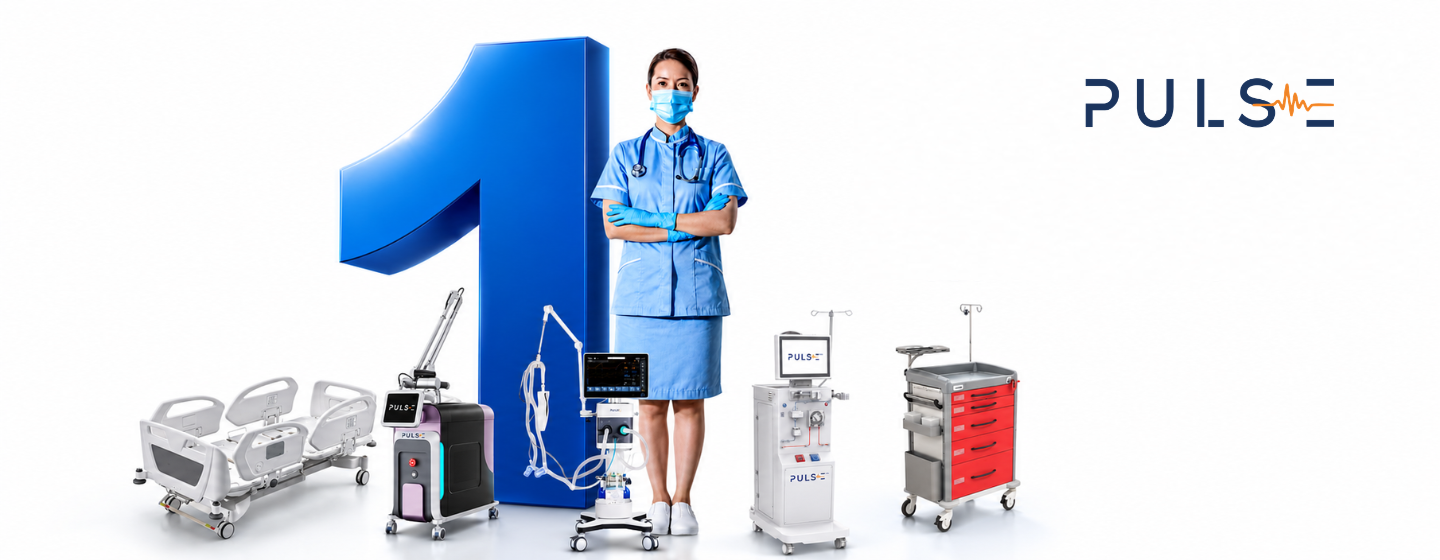
Pulse is built to solve this. A horizontal MedTech OEM brand delivering everything a new or expanding facility needs — from patient beds, wardrobes, over-bed tables, examination couches, wheelchairs and stretchers, to OT tables, OT lights, anesthesia workstations, ventilators, patient monitors, dialysis machines, cardiac catheterization consumables, aesthetic lasers, rehabilitation devices, and small-but-critical items like BP monitors, pulse oximeters, and instrument trolleys.
Seven verticals under one accountable partnership:
- Critical Care — ventilators, patient monitors, infusion pumps, anesthesia workstations
- Renal Care — dialysis machines, dialysers, catheters, tubing
- Cardiac Care — stents, guidewires, cath lab consumables, defibrillators
- Aesthetics — laser platforms, skin treatment devices
- Rehabilitation — wheelchairs, therapy devices, mobility aids
- Hospital Setup — ICU beds, general ward beds, OT tables, OT lights, examination lights, bedside cabinets, over-bed tables, medicine trolleys, wardrobes, chairs, and complete room furniture
- Surgical — instruments and disposable procedure kits
No more juggling vendors. No more disappearing service. No more waiting weeks. Pulse is a horizontal MedTech OEM brand — bringing quality, service, speed, and value into one accountable partnership.
For a new hospital, a mid-size expansion, or a distributor building a multi-category portfolio, that means one order, one point of contact, one service network, and a dramatically simpler procurement path.
See how Pulse's procurement partnership works →
Sources & Citations
- Market size forecasts: Mordor Intelligence, "India Medical Devices Market Report 2025-2031" (2026 estimate $18.30B, 2030 forecast $26.66B at 7.82% CAGR); IBEF Medical Devices industry report; Trade.gov "India Medical Devices" market intelligence ($15.2B 2025 → $50.1B 2030 higher-growth scenario).
- Import dependency: India Brand Equity Foundation industry data; U.S. Trade.gov market intelligence noting ~70% import reliance; Whales Book industry analysis on ~60% share of electro-medical imports.
- PLI scheme progress: India Briefing "India's Medical Devices Sector: PLI Progress & 2026 Outlook" (December 2025); Medical Buyer "India's medical devices sector stands at inflection point"; Invest India MedTech sector data. Cumulative sales approx INR 12,344 crore, of which INR 5,869 crore in exports as of September 2025.
- GST 2.0 rationalisation: ClearTax "GST on Medicines and Pharmaceuticals" (September 2025); Bajaj Finserv Medicine HSN Code guide (September 2025); Busy.in GST rates on medical equipment. Effective 22 September 2025 per the 56th GST Council meeting.
- CGTMSE scheme: CreditCares citing CGTMSE official website. Requires Udyam registration. See cgtmse.in.
- MDR 2017: CDSCO official FAQ document on Medical Devices Rules 2017; G.S.R. 102(E) notification dated 11.02.2020 phasing all medical devices into the licensing regime.
- CDSCO import license fees: Corpzo "Import License for Medical Devices in India CDSCO Guide"; TraccGlobal CDSCO import license documentation; ELT Corporate "Medical Device Import License India 2026"; CDSCO SUGAM portal fee schedule. Fees are payable via TR-6 challan or online through SUGAM.
- Import license processing timelines: TraccGlobal, Corpzo, Morulaa India Medical Device Registration guides. Class C/D applications may include a 60-day site inspection window per MDR 2017.
- Import license validity: source consensus varies between "valid indefinitely with 5-year retention" (TraccGlobal, ELT Corporate) and older references to fixed 5-year validity (Corpzo). Confirm current status with CDSCO before making renewal assumptions.
- GST rate structure post-rationalisation: 56th GST Council notification; ClearTax, Bajaj Finserv, RegisterKaro, Busy.in, GetSwipe compilations. Verify HSN classification for specific products before invoicing.
- Interest rate benchmarks: CreditCares "Medical Equipment Loan In India (2026)"; CreditCares "Medical Equipment Loans In India 2026"; SMC Finance medical equipment finance product page; Axis Bank medical equipment finance disclosure; Financeseva healthcare finance data.
- Income tax depreciation: Section 32 Income Tax Act and Income Tax Rules 1962 depreciation schedules. Life-saving medical equipment typically at 40% under Rule 5; general medical equipment at 15%. Verify specific device classification with a qualified Chartered Accountant.
- Domestic manufacturer base: Invest India MedTech sector overview; Whales Book industry analysis; National Medical Devices Policy 2023 industry structure data.
- AMC/CMC benchmarks: Industry consultancy averages compiled from healthcare procurement advisory sources. Actual AMC pricing varies materially (typically 5-15%) by equipment class, vendor, and negotiation. Treat as directional, not fixed.
- Monitoring device CAGR: Mordor Intelligence India Medical Devices Market segmentation data (2025-2031 forecast).