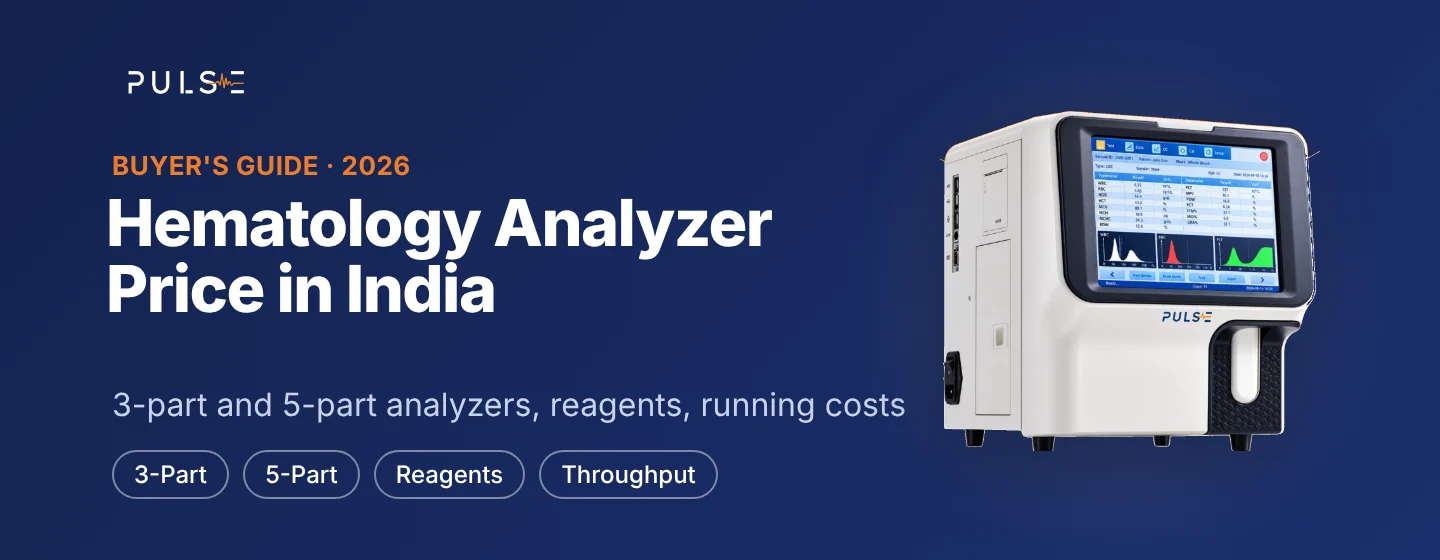
Hematology Analyzer Price in India: 3-Part and 5-Part Compared
Hematology analyzers in India range from under Rs 2 lakh to well over Rs 4 lakh. This guide explains the price bands, the 3-part versus 5-part difference, and the running costs that matter more than the purchase price.
How much does a hematology analyzer cost in India? Online listings in October 2026 show fully automatic 3-part hematology analyzers at about Rs 1.7 lakh to Rs 4 lakh and entry 5-part analyzers at about Rs 3.6 lakh to Rs 3.9 lakh. High-throughput 5-part systems for large labs cost considerably more. Running costs depend mostly on reagents.
Hematology Analyzer Price Ranges in India
| Analyzer type | Listed price range | Best suited to |
|---|---|---|
| 3-part, fully automatic | Rs 1.7 lakh to Rs 4 lakh | Clinics, nursing homes, small and mid-sized labs |
| 5-part, entry level | Rs 3.6 lakh to Rs 3.9 lakh | Hospital labs, growing diagnostic centres |
| 5-part, high throughput | Quote-based, higher | Large hospital and reference labs |
These are listed prices from an online medical store in October 2026, usually before GST, and vary with brand, throughput and bundled reagents.
3-Part vs 5-Part: What Is the Difference?
Both count red cells, white cells and platelets and report the standard CBC. The difference is in the white cell differential:
- 3-part: lymphocytes, mid-size cells and granulocytes.
- 5-part: neutrophils, lymphocytes, monocytes, eosinophils and basophils.
For a full comparison, read 3-Part vs 5-Part Hematology Analyzer: Which Does Your Lab Need?
What Drives the Price
1. Differential and technology
5-part analyzers use extra optical or chemical methods to separate all five white cell types, which raises cost.
2. Throughput
Analyzers running 60 to 72 tests an hour suit most small and mid-sized labs. Higher-throughput systems with autoloaders cost more.
3. Reagent system
Fewer reagents mean lower running cost and simpler stock management. Closed (RFID-tagged) reagent systems improve traceability.
4. Software, QC and connectivity
Built-in QC programs, large result storage, and LIS connectivity matter for accredited labs.
5. Service and reagent supply
An analyzer is only useful if reagents arrive on time and an engineer can fix faults quickly.
Pulse IVD Analyzers at a Glance
| Model | Key details |
|---|---|
| ZT360 Auto Hematology Analyzer | Fully automatic 3-part; 60 samples per hour; 10.4-inch touchscreen that works with gloves; RFID reagent identification; only 2 reagents; cyanide-free HGB; storage for over 100,000 records |
| ZT370 3-Part-Diff Hematology Analyzer | 72 tests per hour with a double-chamber design; 2 reagents (diluent and lyse); optional RFID closed system; 10.4-inch touchscreen; four QC modes; storage for up to 1,000,000 results |
| ZT Smart SAA Biochemistry Analyzer | For labs adding biochemistry tests alongside hematology |
Hematology Analyzer Price in India: Key Facts
- Fully automatic 3-part hematology analyzers are listed at about Rs 1.7 lakh to Rs 4 lakh in India.
- Entry 5-part analyzers are listed at about Rs 3.6 lakh to Rs 3.9 lakh.
- A 5-part analyzer separates all five white blood cell types; a 3-part separates three groups.
- Reagents are the main running cost.
- The Pulse ZT370 runs 72 tests an hour using only 2 reagents.
Hematology Analyzer Price in India: FAQs
How much does a hematology analyzer cost in India?
Online listings in October 2026 show fully automatic 3-part hematology analyzers at about Rs 1.7 lakh to Rs 4 lakh, and entry 5-part analyzers at about Rs 3.6 lakh to Rs 3.9 lakh. High-throughput 5-part systems for large labs cost considerably more.
What is the difference between a 3-part and 5-part hematology analyzer?
A 3-part analyzer splits white blood cells into three groups: lymphocytes, mid cells and granulocytes. A 5-part analyzer separates all five types: neutrophils, lymphocytes, monocytes, eosinophils and basophils, which helps with infections, allergies and blood disorders.
Is a 3-part hematology analyzer enough for a small lab?
For most clinics, nursing homes and small labs running routine CBCs, a 3-part analyzer is usually enough. Labs serving hospitals with oncology, paediatrics or many abnormal samples often prefer 5-part.
What are the running costs of a hematology analyzer?
Reagents (diluent, lyse and cleaners), controls and calibrators, printer paper, and an AMC. The cost per test depends mostly on reagent use, so analyzers that need fewer reagents usually cost less to run.
What should I check before buying a hematology analyzer?
Check 3-part or 5-part, throughput (tests per hour), sample volume, number of reagents and whether they are closed or open, QC features, data storage and LIS connectivity, cyanide-free haemoglobin, and local service and reagent supply.
How do I get a price for Pulse hematology analyzers?
Message Pulse on WhatsApp at +91 90711 01108 with the model (ZT360 or ZT370), your daily sample volume and city, and the team will share a quote.
Sources
- Hematology Analyser listings (Medikabazaar, accessed October 2026): listed prices for 3-part and 5-part analyzers
- Pulse ZT360, ZT370 and ZT Smart SAA product pages: analyzer details
Related Reading