Radial vs Femoral Access: Wrist or Groin for Angiography?
Angiograms and angioplasties can be done through the wrist or the groin. This guide compares wrist (radial) and groin (femoral) access, explains why guidelines prefer the wrist, when the groin is still used, and how teams protect the radial artery.
Radial (wrist) access causes less major bleeding and is linked to lower death rates than femoral (groin) access, and needs shorter bed rest. In a 2022 analysis of 21,600 patients, 30-day deaths were 1.6% radial vs 2.1% femoral. The groin is still used for large devices, some complex procedures, or when the wrist artery is too small or blocked.
Two Routes to the Heart
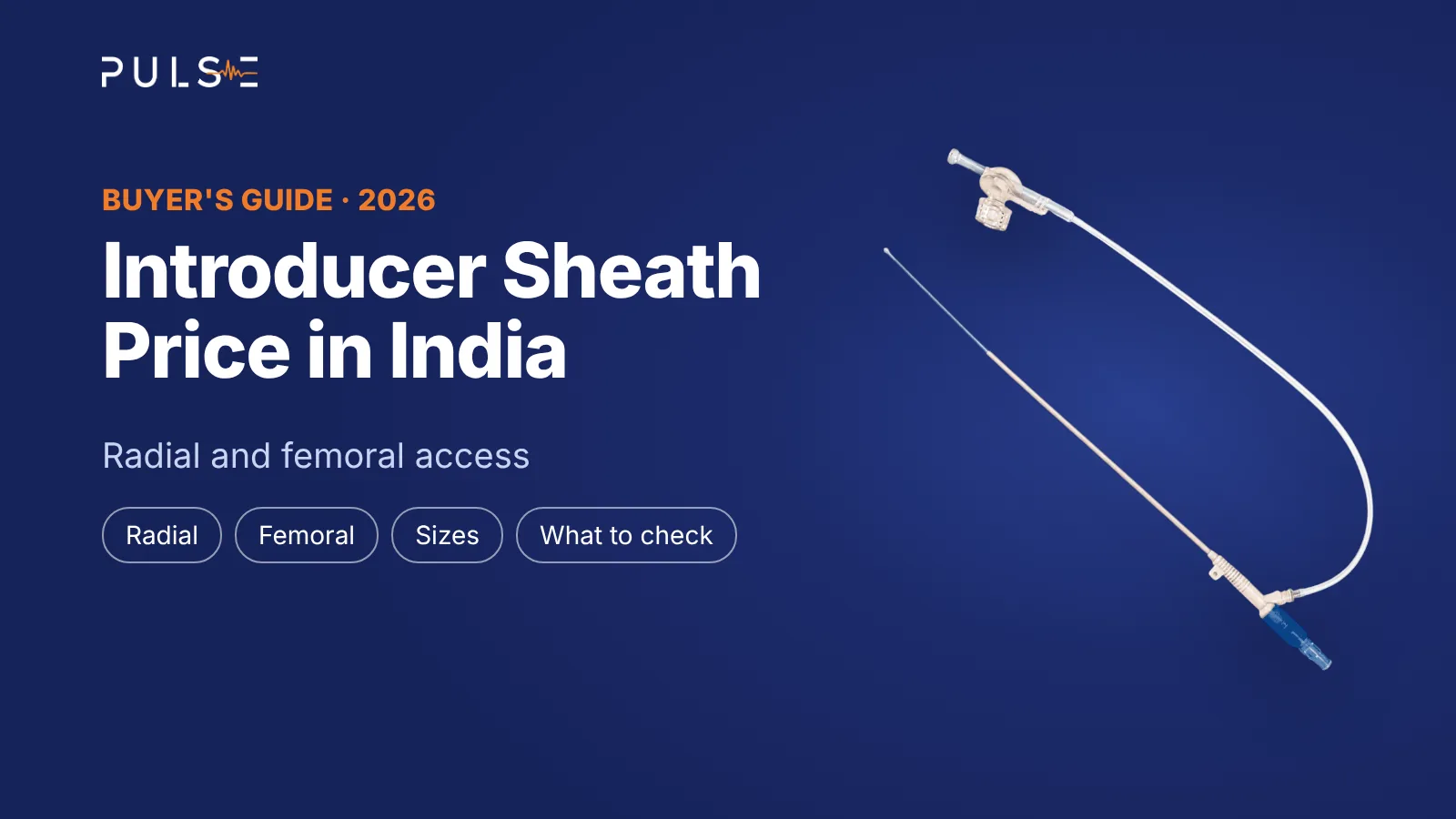
To reach the heart arteries, the cardiologist places a short tube called a sheath into an artery, either at the wrist (radial) or the groin (femoral). Catheters, wires, balloons and stents all pass through it. See our introducer sheath price guide.
Radial vs Femoral at a Glance
| Radial (wrist) | Femoral (groin) | |
|---|---|---|
| Major bleeding (30 days, 2022 analysis) | 1.5% | 2.7% |
| Death (30 days, 2022 analysis) | 1.6% | 2.1% |
| Bed rest after the procedure | Shorter | Longer |
| Artery size | Small | Large |
| Main risk | Artery may block or spasm | Bleeding or a blood collection in the groin |
The 2022 figures come from a patient-level analysis of 7 trials presented at the European Society of Cardiology congress. About 95% of patients had a heart attack or unstable angina, so the researchers said the results cannot be fully applied to planned procedures.
Stocking a cath lab?Get a written quote, brochure or demo from the Pulse team.
Why Guidelines Prefer the Wrist
A 2025 review sums up the evidence. In a pooled analysis of 31 studies, radial access cut the odds of major bleeding by about half and of death by about a quarter compared with femoral access. In one trial, bed rest was about 5 hours with radial access against about 10 hours with femoral. A national analysis in England found radial procedures cost about 22% less. This is why many centres now follow a "radial first" approach.
When the Groin Is Still Used
- Large-bore devices or some complex procedures that need a bigger sheath.
- Small, twisted or spasming wrist arteries, where the wrist route fails.
- Patients who have had bypass surgery, where the radial artery may be needed as a graft.
Protecting the Radial Artery
The main problem with wrist access is that the radial artery can block afterwards. A 2025 review cites rates of up to 19.7%. Teams lower this risk by:
- Using smaller, hydrophilic (slippery) sheaths.
- Giving drugs that relax the artery, such as nitroglycerin and verapamil.
- Pressing the wrist only firmly enough and only as long as needed, while keeping blood flowing through the artery.
Distal radial access, at the base of the thumb, is a newer option. A pooled analysis found a much lower risk of the artery blocking, but the artery there is smaller and the puncture takes longer to learn.
Starting With a Small Puncture
Micropuncture kits use a very thin 21G needle and a fine 0.018 inch wire. The small hole is easier to place, especially with ultrasound, and causes less harm if the first try misses. A dilator and sheath then widen it to the size needed. See our coronary angiography cost guide.
Pulse Access Kits
Pulse AcuSafe micro-access kits come with sheaths from 4F to 8F in 5.75 cm and 11 cm lengths, colour-coded hubs, a 21G needle and a 0.018 inch wire. Echogenic needles, which show up better on ultrasound, are available on selected kits. Pulse also supplies AcuSafe introducer kits.
Radial vs Femoral Access: Key Facts
- Radial access causes less major bleeding than femoral access.
- In a 2022 analysis of 21,600 patients, 30-day deaths were 1.6% radial vs 2.1% femoral.
- The benefit was shown mainly in heart attack and unstable angina patients.
- Femoral access is still used for large devices and when the wrist artery is unsuitable.
- Small sheaths, artery-relaxing drugs and gentle compression help keep the radial artery open.
Radial vs Femoral Access: FAQs
Is radial or femoral access better for angiography?
Radial (wrist) access causes less major bleeding and is linked to fewer deaths, especially in heart attack patients. Bed rest is also shorter.
Why is angiography done through the wrist?
Because trials show less major bleeding and fewer deaths than groin access, with shorter bed rest and lower hospital costs.
When is femoral (groin) access still used?
For large devices or some complex procedures, when the wrist artery is too small, twisted or in spasm, or in some patients after bypass surgery.
Can the radial artery block after angiography?
Yes. A 2025 review cites rates of up to 19.7%. Small sheaths, artery-relaxing drugs and gentle compression lower the risk.
What is distal radial access?
Access at the base of the thumb instead of the wrist. Studies show a lower risk of the artery blocking, but the artery is smaller and the technique takes practice.
Does Pulse supply micro-access kits?
Yes. Pulse AcuSafe micro-access kits come with 4F to 8F sheaths, a 21G needle and a 0.018 inch wire. Message +91 90711 01108 for a quote.
Sources
- Radial access for coronary interventions confers lower mortality than femoral access (European Society of Cardiology press release, 29 August 2022): 7 trials, 21,600 patients, 30-day death and bleeding
- Radial artery access in interventional cardiology: a review of current practices (Advances in Interventional Cardiology, 19 December 2025): pooled bleeding and death data, bed rest, cost, limits, artery blockage, distal radial access
Related Reading