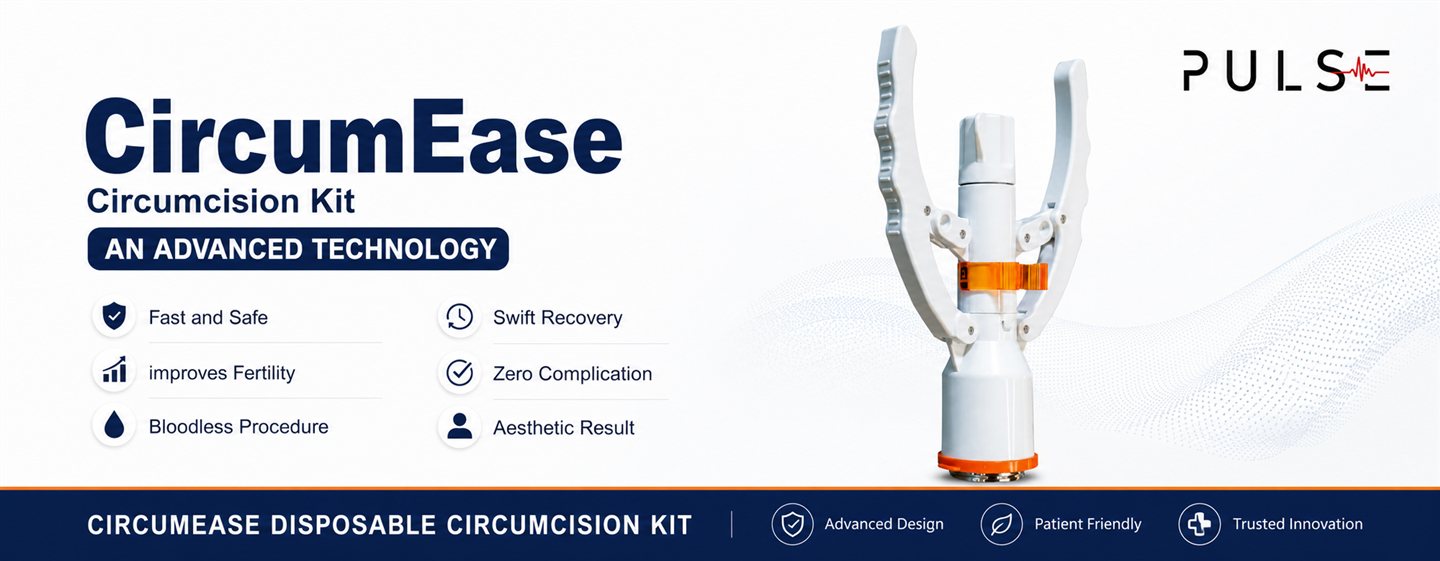
What is CircumEase? A Complete Guide to Disposable Circumcision Kits
Circumcision is one of the most commonly performed surgical procedures in the world. But for decades, the tools used varied widely, from traditional surgical blades and sutures to improvised methods. This left outcomes inconsistent and recovery unpredictable.
That's where disposable circumcision kits come in. And that's exactly what Pulse's CircumEase was built to solve.
What is a Disposable Circumcision Kit?
A disposable circumcision kit is a sterile, single-use surgical device. It standardizes the entire circumcision procedure from start to finish. Instead of assembling a tray of reusable instruments (clamps, scalpels, sutures, sterile drapes), the clinician gets one sealed kit with everything they need, pre-sterilized and ready to use.
The key word here is standardization. Every kit is identical. That means the outcome doesn't depend on how skilled the scrub nurse was that day, whether the autoclave was properly loaded, or whether the instruments were adequately sterilized between uses.
This procedure is performed on newborns, children and adults, across government hospitals, private clinics and camp settings. That consistency matters enormously.
What's Inside the CircumEase Kit?
The CircumEase kit by Pulse is designed for complete procedural readiness. A standard kit typically includes:
- Circumcision device — the primary instrument for controlled foreskin removal
- Sterile drapes — to maintain a clean surgical field
- Prep swabs and antiseptic solution — for pre-procedure site preparation
- Sterile gloves — single-use, included to eliminate a separate procurement step
- Gauge and dressing material — for post-procedure wound care
Everything arrives sealed in a sterile pouch. Open, use, dispose. No sterilization cycles, no instrument tracking, no risk of cross-contamination between patients.
How Does It Work?
The modern disposable circumcision kit uses a ring-clamp or stapler mechanism. This is a significant improvement over the traditional suture-based approach. Here is how a typical procedure looks:
Step 1 — Preparation
The surgical area is cleaned using the antiseptic prep swabs included in the kit. Sterile draping is applied.
Step 2 — Sizing
CircumEase kits are available in multiple sizes to accommodate different patient ages and anatomies — neonates, children, and adults. The right size is selected before the procedure begins.
Step 3 — Device Placement
The device is carefully positioned. The inner component fits beneath the foreskin while the outer ring sits over it, effectively sandwiching the tissue.
Step 4 — Foreskin Removal
Once correctly positioned, the device cuts the foreskin cleanly. At the same time, it applies even pressure to reduce bleeding. In many cases, no suturing is required, since the wound edges naturally come together under this pressure.
Step 5 — Dressing and Discharge
The included dressing material is applied. Most patients can be discharged the same day.
Compare this to the traditional approach: a scalpel incision, manual haemostasis, multiple individual sutures, a longer procedure, and a recovery period that can stretch to 2–3 weeks. The disposable kit approach typically cuts procedure time in half and reduces complications after surgery.
Why Are Hospitals Switching to Disposable Kits?
If you run a urology ward, a camp circumcision programme, or a busy district hospital, infection control is a real concern. In these settings, the case for disposable kits is straightforward.
1. Infection Control
Reusable instruments carry a real risk of biofilm buildup and inadequate sterilization. A disposable kit removes this risk completely, since each patient gets instruments that have never been used before.
2. Procedural Efficiency
There is no pre-operative instrument counting, no post-operative decontamination, no autoclaving wait time. The kit is ready when the surgeon is ready.
3. Consistent Outcomes
Standardized kits produce standardized results. The learning curve for junior surgeons and medical officers is shorter, and outcomes in high-volume camp settings are more predictable.
4. Cost-Effectiveness at Scale
A disposable kit does have a per-use cost. But factor in the labour, utilities, equipment maintenance and infection-control costs of reusable instrument sets, and the numbers often favour disposable kits for mid-to-high volume settings.
5. Regulatory Compliance
India's healthcare sector is moving toward stricter infection control rules under NABH and state health authority guidelines. Under these rules, single-use instruments are becoming the standard rather than the exception.
Who is CircumEase For?
CircumEase is designed for use in:
- Government hospitals and PHCs conducting routine or camp-based circumcision programmes
- Private urology and general surgery clinics looking to streamline theatre workflows
- Paediatric and neonatal units where the patient population demands the highest hygiene standards
- Military and field medical settings where instrument sterilization infrastructure may be limited
The kit is suitable for neonatal, paediatric, and adult circumcision — with sizing available to match patient anatomy.
How Pulse is Different from Other Brands
No more juggling vendors. No more disappearing service. No more waiting weeks. Pulse is a horizontal MedTech OEM brand — bringing quality, service, speed, and value into one accountable partnership.
Pulse holds ISO 13485 certification, the international quality management standard for medical device manufacturers. All products undergo rigorous quality testing before dispatch.
The Bottom Line
Circumcision is a routine procedure, but routine doesn't mean it should be handled carelessly. Every patient deserves a procedure performed with sterile, standardized tools, regardless of age, location, or the setting they walk into.
CircumEase exists to make that standard of care accessible, consistent, and affordable across India.
If you're a hospital procurement team, a urology department head, or a public health programme manager looking to upgrade your circumcision protocol, the CircumEase kit is worth a close look.
Visit CircumEase Product Page →